Thailand: VLOGS!!!
In news that is completely unrelatable to my usual video game spiel... I recently spent a month travelling around Thailand armed with a Sony Bloggie. I videoed alot of footage and am working tirelessly at producing a series of travel logs documenting my experiences. Its going to be good! The above video is just a taster. Also the music I used was Johnny's Dream by Masters of Reality (good isn't it?) off their Cross Dover album.
If the video doesn't work, check my youtube page... thats right I have a youtube channel, my how I grow... http://www.youtube.com/watch?v=j4wpvUTUdes
Thursday, 23 September 2010

HALO: Reach
remember reach, remember bungie

All in a day's work...
Back in 1999, when there was no Gametrailers or YouTube, avid gamers would rely on a large culture of magazines and demo discs to learn about the next biggest thing in gaming. Occasionally, we may have even come across that rarest of occurrences, the gaming television show. One specific show that I remember with great appeal was Game Over on the now defunct satellite channel .TV. Hosted by Andy Collins, the show provided tongue in cheek despatches from the video gaming world. The Game assassins would review the latest games like Brunswick Pro Circuit Bowling with much relish, whilst the space girls focused on tips in space. The show also marked the humble TV origins of a one Matt Berry, before he went on to greater things, namely Dark Place, The IT crowd and of course those Volvic Mineral Water adverts starring Tyrannosaurus Alan. I am going somewhere with this intro...
Essentially, it was on this show, that I was first introduced to a game that was specifically designed for the Mac by little known developer Bungie. The demo footage revealed a simple but staggering in concept, a buggy, complete with realistic suspension being chased by two purple hover bikes across a strange alien landscape. This was my introduction to Halo. There was talk from the developers of a ring planet, and open ended combat, but there was also talk of co-operative gameplay. The buggy, of which I would come to know of as a Warthog could seat three players. One would drive, whilst another manned the machine gun turret and the third rode shotgun. This was enough to send my thirteen year old mind into overdrive. Co-operative gaming hadn’t come into the mainstream as of yet. We had our split screen Goldeneye, our two player Machine Hunter or Streets of Rage, we may have even been lucky enough to play Counterstrike on a decent connection but the point is, co-operative gaming just didn’t exist as it does today, but it was built into Halo from day one.
I quickly remembered the names Halo and Bungie, to the point I even played Oni, Bungie’s pre-Halo game, a decent enough brawler with a manga art style and a mechanic involving performance enhancing drugs. I watched the development of Halo closely, as it went from a third person shooter for the Mac to first person shooter as the secret weapon behind Microsoft’s new gaming platform The Xbox, the game that was now called Halo: Combat Evolved. I then got an xbox with a copy of Halo, and the rest is history. What I am trying to say is that I am a fan of Halo. I had always been a fan of first person shooters, from Doom to Unreal Tournament, to Half-Life and Perfect Dark, but what Halo did was open the doors and define how first person shooters should be played. With friends. Halo became the reason to buy an xbox, to have 16 player LAN parties. To say Halo broke new ground is an understatement. Halo brought console based first person shooters into vogue, effectively opening up the floodgates. Before Halo, there was only Goldeneye on the N64. There was of course the brilliant Perfect Dark, but nobody brought it, despite it being ahead of the times. Elsewhere what was there? Medal of Honour? Red Faction? If there was no Halo, there would probably be no Call of Duty and certainly no Modern Warfare 2 generating over a billion dollars in sales, as of now the most profitable entertainment event in history. But certainly, Halo did prove that first person shooters could thrive away from the mouse and keyboard and into the more profitable arena of console gaming. It is for this reason that Halo is both loved and hated so passionately.
Halo: Reach is Bungie’s fifth and final Halo game before they go off to spend the next ten years in bed with Activision developing this new supposedly ground breaking IP. Based on the Fall of Reach by Eric Nylund, which was initially written as a prequel to the original game, Reach effectively brings the franchise full circle on itself. Reach itself is a planet, where a fairly large human colony has been based. The planet is also home to the Spartan super soldier program, of which the series’ iconic Master Chief was spawned. The whole marketing strategy behind Reach has been based on the notion that the player already knows what is going to happen to the planet, even if they are unaware of the surrounding fiction. For those who are unaware, Reach is doomed, attacked and glassed by the alien forces of the Covenant. At the start of the original Halo, the Pillar of Autumn, the ship that houses Master Chief and Cortanna, makes a blind jump into slip space after escaping Reach. It is here that they miraculously come across the Halo ring world which kicks off the trilogy.
Halo: Reach has you play as a new recruit to Noble team, a team of Spartans who are supposed to precursor the master chief. Like the Master Chief and the Rookie from last year’s ODST you are a faceless member known only as Noble Six. The strength of the character is that he is entirely of the player’s own creation. The game grants a plethora of armour that you can customise your super soldier with. You unlock new variants as you progress throughout the game, these variants are completely cosmetic and do not affect the way you play the game but they emphasise the connection of the player to the character. You take your character as you initially begin to investigate a distress call from a remote farming location, where it quickly becomes apparent that the planet has been invaded by Covenant forces. What is immediately clear, is a darker more brooding atmosphere, the Halo trilogy feels like a lucid dream in comparison. That said, the game progresses much in the way previous Halos have, you have vague open world levels where you may have a warthog. Other levels will give you a tank, whilst others will encourage flight.
The campaign is excellent in my opinion, probably the best of the series. Despite being of similar length to previous games, the campaign suffers very little down time. Halo 2 and 3 specifically suffered from grind. Piloting a tank is usually fun for the first time but a second time it starts to feel a little stale. In reach, the tank is only limited to one level, which is just about right. The absence of the flood is definitely to the campaign’s benefit as well. Fighting the Covenant has always been the best part of the halo campaign and it is certainly never been better until Reach. The AI has improved and the covenant are once again a threatening prescence. The return of the elites is particularly a welcome re-addition to the series, after suffering the Brutes since the third act of Halo 2. Though the brutes do appear midway through the game, they are nowhere near as tough as the revamped elites, who are, through lack of a better word, ‘proper bastards’. When I first played through the game, I played on heroic difficulty and was quickly cut down upon first encountering the elites on the first level. When the tougher elites are around, you are constantly reaching for the plasma/UNSC pistol combo to despatch them before they swamp you. It gives the alien menace a different energy, they no longer speak in English, grunts no longer run away from you screaming, ‘little people first’. The combat is much tighter, when you are on foot, the holy trinity of gun, grenade and melee works as well as it ever has. There are fewer weapons than other shooters, but every weapon has a particular use. The reworked battle rifle, the DMR is a favourite of mine, but I always find keeping my assault rifle in support in case I need to pepper large swarms of enemies.
The fifth mission is a particular favourite. It begins with you on foot, steamrolling covenant forces across a beach until you get to the launch site, where you begin the much publicised ‘space’ part in which you board a space combat craft and jet up into the planet’s upper orbit. The combat section essentially plays like Lylatt Wars or the space sections in Battlefront 2 as you swat banshees and the shielded seraphs. There is a brief cut-scene in which human forces prepare their next offensive against the covenant, whilst huge explosions silently engulf the planet’s surface like ripples in water, all to the sound of Martin O’Donnell’s majestic score. This would not be a proper review, if I didn’t pay homage to the score, though much of the magic of Halo lies in the music, like the greatest space operas, lies in Martin O’Donnell’s compositions. The space combat is kept quite brief, never outstaying its welcome but leaving a little wanting. The day when multiplayer incorporates space combat with a simultaneous ground battle is the day you get one step closer to making the greatest Star Wars game ever. If Bungie had incorporated this into multiplayer then they may have just revolutionised the genre once again, but maybe this idea is too ambitious for this current generation of consoles. Going back to the level, it progresses with you boarding a covenant space craft in zero gravity, your bullets muffled by the vacuum of space. With the atmosphere that very much conveys the feel of the ‘belly of the beast level’ from the original Halo you fight your way through the corridors of the space craft until you reach the control room, before escaping the ship before it all goes up in a glorious explosion.
The Fall of Reach is undoubtedly a catchy title for a book, but is it a good narrative for a game? How can a genre like the first person shooter, which essentially relies on conveying the fantasy of empowerment over hordes of enemies, tell the story of mass genocide? Where not even your own character makes it out alive no less. It is an intriguing theme to be sure and it is certainly not the first game to try to grapple with this concept. The modern warfare series has frequently done this, probably most effectively in COD4, when you control a US marine as he staggers through a silenced warzone under the shadow of a mushroom cloud, doomed. In Reach, you finish the campaign, successfully completing your mission and all that stops you from the end credits is a firefight section. The atmosphere is dusty and covenant drop ships roam the skies like sharks at feeding time. As you take damage, your visor cracks and splinters until finally you are beaten. Though it does not prevent you from trying to survive the onslaught, just to see whether you can survive Reach, or see that final cutscene when your character walks off into the sunset, alive to fight another day. It was the only way to finish the game really, but compared to say Modern Warfare, where you were constantly dying as you were running down that frikking hill to get to the helicopter whereupon the narrative kills you anyway. Reach was alot more satisfying, but I think it comes down to mood.
Mood is what elevates Halo over other first person shooters and it is something that only real Halo fans can see. There has always been a sense in Halo that you are exploring and fighting in a real world, more so in Reach, where Bungie have spent more time on level design to create a believable world. A common criticism of the Halo trilogy was that it did not have much variety in its indoor sections, which were essentially the same maps stuck together. Conflict in Halo, always made you feel you were part of something big. Enemies don’t just spawn into the map, they are usually dropped in via drop ships. They feel as if they are part of a larger machine; with you, the player, in the position of antagonist. I like the Call of Duty games, don’t get me wrong. But I do feel that Halo has something special. Whereas Call of Duty offers a shooter experience that is grounded in realism and tighter shooting mechanics, the joy of Halo multiplayer has always been in the variables. It is about walking into a man cannon at just the right time when you hijack a marauding banshee in midair. It is about tagging that bastard with the awesome helmet, ending his spree in a phenomenally cathartic blue explosion. It is about rocket firefight, where you gleefully jetpack over a hordes of grunts with unlimited ammo. It is about careering through the campaign in a warthog with your friends, feeling invincible. This is part of the reason why Bungie implemented the theatre section to the game, so that you could capture these monumental moments, but it was also to display the sheer amount of activity that was going on at one time, whilst you were seeking to hi-jack that ghost. In Halo 3 for example, whilst you were tackling the scarab, you could use theatre to focus on one of the hovering pelicans, you can see the soldiers in its hold. You could see allied AI picking targets. With Halo, there is little in the sense of smoke and mirrors, that is rife in so many other video games, the battle is all there to be displayed, scrutinised from every angle it is as if Bungie dare you to attempt to catch their engine out.
I haven’t even begun to review the other components of the game. The multiplayer, the firefight modes, the challenge structure or even Forge World, which now allows players to create their own maps. Forgeworld is effectively a gigantic map, a playground where you can spawn in various items and objects, creating your own structures for multiplayer. The hardened PC player is likely to guffaw at this mode in comparison to modding culture that surrounds titles like Half-Life, but it is still there, should players want to milk more out of their game. Judging what has been accomplished with Forge in Halo 3, we are going to be seeing all manner of ingeniously made structures. If I may make one request, a massive Mad Max style Thunder Dome, with interlinking raceways for use of Mongoose.
I haven’t even begun to review the other components of the game. The multiplayer, the firefight modes, the challenge structure or even Forge World, which now allows players to create their own maps. Forgeworld is effectively a gigantic map, a playground where you can spawn in various items and objects, creating your own structures for multiplayer. The hardened PC player is likely to guffaw at this mode in comparison to modding culture that surrounds titles like Half-Life, but it is still there, should players want to milk more out of their game. Judging what has been accomplished with Forge in Halo 3, we are going to be seeing all manner of ingeniously made structures. If I may make one request, a massive Mad Max style Thunder Dome, with interlinking raceways for use of Mongoose.
After the understated release of Halo 3 ODST last year, Reach is a return to form for the franchise. It does not really do anything new with the franchise it is an accumulation and a perfecting of everything that has made the franchise great over the last nine years. There are a few negatives, the frame rate chugs at times when things get extra chaotic and the checkpoint system can be a little frustrating. Regardless, these aren’t even scratches in the game’s reputation. It is a complete package, the campaign is endlessly replayable, designed with a new found affinity for four player co-op, when that fails, the multiplayer suite will have players playing for years to come. Halo and the master chief are sure to return to us in some form. Microsoft will be sure of that. Whether it will be as good without Bungie is another matter.
Monday, 20 September 2010
Rental Review Roundup
A couple of months ago, I started an account with LoveFilm with the sole purpose of renting out various video gaming titles that I have missed out on, partly through financial frugality, but also because of the sheer awesome torrent of activity that modern life forces upon me in spite of gaming. In short, renting is great. You don’t have to commit anything, if a game is rubbish, you can send it back in the mail and get the next title. You also get a serious boost to your gamer score. An apt metaphor would be presented as a happy marriage between prostitution and penis enlargement basically.
Heavenly Sword.
Originally released in 2007 and exclusive to the PS3, Ninja Theory’s Heavenly Sword has been on my list for a while because I am always interested in a Sony exclusive, being a playstation kid at heart. Ninja Theory are back in recent news, with new game Enslaved: Odyssey of the West coming out in early October and a reboot of Devil May Cry currently in development. The studio have built strong ties with actor Andy Serkis, who leant his acting experience with motion capture technology to both Heavenly Sword and their next game Enslaved: Odyssey of the West, which he not only directed but starred in, as a beefcake version of himself.
You play as Nariko, a red haired Amazonian woman voiced by Anna Torv who finds herself wielding the heavenly sword, a weapon of great power that is prophesised to rid the world of great evil, though in so doing, it corrupts the mind of the warrior using it, lord of the rings style. Sought after by Andy Serkis’s big bad emperor, King Boham and his colourful axis of evil, Nariko must protect the heavenly sword whilst battling evil constantly. This all takes place in a colourful fantasy world that is influenced by Eastern oriental imagery.
Nariko has the potential of being one of those rare things in gaming, a balanced heroine that is not overly sexualised like Lara Croft or characteristically mute like Samus Arran. Most crucially she is a woman in a man’s world. The back story of the game reveals that Nariko is identified by this, a disappointment to her father for being born a woman, her birth resulting in the death of her mother. The heavenly sword itself is a weapon to be wielded by a man. The feminist gamer could read into the opening of the game, a flash forward sequence in which Nariko fights a losing battle against a horde of enemies, all men.
Gameplay wise, combat is the name of the game. Essentially, Heavenly Sword is an action/combat game that uses the popular God of War template of accessible combat, quick time events and ‘brutal’ finishers. The combat is effective though predictable, you use light/heavy attacks interlaced with acrobatic evades and the odd finishing move which usually sees her thighs breaking his neck. The sword you wield essentially functions as three different weapons, fast attacks, ranged attacks and heavy attacks, different enemies require different strategies and the controls of the game keep the combat relatively easy to fight, whilst giving a degree of depth and development as you fight harder enemies. Simply it works.
Unfortunately, In the style of most of the early PS3 exclusives the game places much emphasis on using the six axis controls where ever necessary. Thusly you get these annoying sections where you take control of Nariko’s sidekick Kai who fires arrows which you control individually with the sixaxis. It is certainly not a broken mechanic but it becomes tedious and is really the only deviation from the more conventional combat that comprises the bulk of the game.
One of the game’s saving graces is Andy Serkis, who really adds character and humour to the game. Though Nariko’s quest is formulaic and overtly serious, some cut scenes centres upon King Boham and his plotting with his axis of evil. These scenes are genuinely funny, a bit like those scenes with Doctor Evil in the Austin Powers movies. These cut scenes are well acted and wittifully written and are even worth playing through the lacklustre levels just to watch. Though you could just Youtube them...
Heavenly Sword is a functional brawler to be sure. Combat is tight and satisfying. Cosmetically the game even after three years still holds up well. In the end however, I felt the game was a bit too shallow in gameplay. Ninja Theory went to great lengths to create this big bright world and all these remarkable vistas, but the controls do not even grant you a jump button. The game, world and story could have benefited from explorative elements. Even God of War grants you a certain degree of freedom between each choke point, in which you battle against enemies. Heavenly Sword is too linear for its own good, going from arena to arena via one of the terrible six axis ventures leading finally up to a boss fight.
FEAR 2
I had played the first FEAR a couple of years ago, but was put off by the game’s sterile environments and tacked on scare tactics. Regardless the fire fights were impressive and there was a certain satisfaction slow-mo kicking some hapless goon in the face. With this in mind, I tried FEAR 2 with an open mind and suddenly realised just how competent an FPS it really is.
This is an amazing feat particularly when there is nothing in FEAR 2 that strikes me as unconventional of the genre. We have seen the same settings: deserted offices, apocalyptic urban environments and dark pipe lined sewer tunnels in hundreds of other games, the first FEAR being a good example in itself. We have seen the same mechanics, a slow motion bullet-time ability that gives you an edge over your enemies. We have fought against the same enemies, a faceless mercenary bunch and the odd monster or two. What makes FEAR2 brilliant is its combat, its frenetic and visceral fire fights. The developer clearly realise which elements go into a great shooter. The guns all feel powerful, there is a technique to using each. The enemies are controlled by a decent AI system, which has them run for cover and throw grenades. On hard difficulty, these enemies pose a significant challenge and you constantly feel blessed when you have the ability to go slo-mo and see each of your shots landing. Killing said enemies is a gory business particularly if you fire a shotgun at close range for example. Then there are the environments, which all react realistically in the middle of a fire fight. Glass shatters, paper flies, and bullet holes puncture the walls. Of course when guns fail there is possibly no better feeling than roundhouse kicking a guy to the face.
The game is let down by the horror elements which try in earnest to scare you at every possible moment. The game is called FEAR, so I guess the developers thought that this is the direction they were supposed to go in but it is all so woefully contrived. I paid no attention to the plot or the various bits of information you pick up throughout the game, but you are followed by Alma, a supernatural entity that is basically the girl from the Ring. Essentially she covets you, messes with your mind, floating objects in front of you, whilst killing off other people for the sheer hell of it. Sometimes she grabs you from out of nowhere and you have to rapidly press the B button just to get her off. Along with Alma, you will also be tasked with fighting off other supernatural entities including puppet master beings who bring the corpses of the dead to life and ghost like beings that are almost invisible save from the faint flicker of their form. Fighting these enemies offers a different experience but is nowhere near as good as fighting the generic soldiers.
In conclusion, FEAR 2 offers a challenging and engaging shooter experience, that works brilliantly at conveying John Woo style shoot outs. It caught me completely by surprise and easily stands up against Halo, Modern Warfare and Killzone 2 in the heavily populated FPS arena. Combat is satisfying and endlessly replayable. It is let down only by the tacked on 'horror' sequences but I'd still recommend any shooter fan to check this game out.
50 Cent’s Blood on the Sand
I rented this game after laughing about it and then hearing several favourable reviews. I am no fan of 50 Cent's music, and the game didn't make me any more partial. I am white, with a capital ‘why’. In fact what I ended up doing was playing classical music through my xbox hard drive and thusly playing the game accompanied by Canon in D minor.
50 Cent: Blood on the Sand is a third person shooter starring Mr 50 Cent, various members of G-unit and even Lance Reddick from Lost and The Wire! The game takes place in some anonymous war torn middle eastern country, where 50 is performing a gig through which he is paid by means of a priceless diamond encrusted skull. Of course things do not run smoothly, 50 is ambushed, and some strange woman runs off with his skull, to which 50 responds with the immortal line - 'Bitch stole my skull!' This puts in motion an epic quest through city streets, and ancient ruins fighting off waves and waves of bad guys and no less than five helicopter gunship boss fights.
As a third person shooter the game works remarkably well. Shooting is satisfying and addictive as the game throws many mini-challenges throughout each of the levels, boosting your score. The game is let down by a dodgy cover system which often feels transparent to bullets and perhaps a lack of commitment to the cause. The game’s saving grace is that it does not take itself seriously, the game is so obviously tongue in cheek. Seeing 50 cent finish a bandanna wearing bad guy with a knife to the chest is hilarious rather than grim. 50 Cent and his accompanying G-unit sidekick fire off various insults (insults you can UNLOCK through points!) whilst spewing out all the conventional military verbatum. You begin to wonder where 50 Cent and G-unit received all this military training. Life on the streets must have been tough, and though Mr Cent was famously shot nine times you still question his involvement in Middle Eastern affairs.
In conclusion, this game is well worth a rental at least. It has co-op so you can enjoy the gangsta rap lunacy of it all with a friend and a degree of replayablility as you rack up more and more ‘ice’ to get the gold medal for each level. It pushes all the right buttons and if you do actually like 50 Cent then this will probably be the best game ever made.
Dante’s Inferno
In keeping with the winning formula of God of War series, Dante's Inferno seeks to emulate a piece of classical literature through ultra violence and minor titillation. Visceral Games, the makers of Dantes’ Inferno also made Dead Space, which used the conventional survival horror formula to great effect and actually bettered Resident Evil 5. Unfortunately, in emulating the God of War formula, playing Dante's Inferno only reminds you how good those games were in comparison. It isn’t just the combat and the green health orbs, the entire story is told in the exact same way as the original God of War. Of course what Dante’s Inferno also adds to the mix is actual shit. Not just through shoddy level and tasteless monster design but some of the enemies do actually attack you with their own excrement...
In a nutshell, you play as Dante, a knight fighting through the crusades, who may or may not be guilty of one or two of the seven deadly sins. His beloved Beatrice is killed and taken to hell, thus Dante must battle through the nine circles of Hell and come out on top against serial wanker Lucifer. You are made to fight various monsters and demons ranging from the usual undead footsoldiers, siren like entities that shoot scythed tentacles out of their vaginas and these gluttonous worms that are essentially penises with teeth, a concept which people are naturally supposed to find fearful at a deep psychological level. The boss for the lust level also produces attack babies out of her breasts. Yeah, it is that kind of game... Dante’s Inferno’s problem is that it tries too hard to shock the player. Whilst God of War is violent in a gleeful way, Dante’s Inferno just tries too hard. In attempt to deepen the combat, Dante’s Inferno gives the player the choice over whether to punish or absolve your enemies. The former being the way to the dark side whilst the latter is effectively a stairway to heaven, giving you points which unlock more powerful moves. Ramping up the difficulty only increases the amount of hits it takes to bring down an enemy. Effectively, the various demons begin to feel like super absorbent sponges rather than an actual challenge.
Though rated as an 18, Dante's Inferno feels inherently juvenile. If there is a hell, it is probably being made to play Dante's Inferno for all eternity. There are so many better God of War clones to play now. If the God of War trilogy didn’t satisfy you, there is Wolverine’s Revenge, Force Unleashed and the actually really good Darksiders by Vigil games. I’ve talked too much about this game. Let’s talk about something else...
Heavenly Sword.
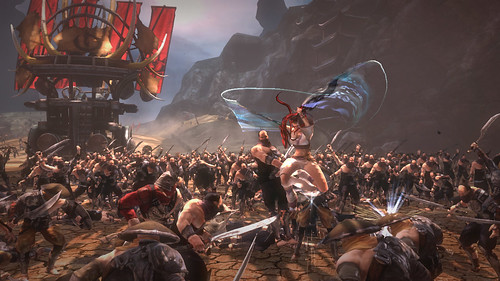 |
| This is a man's world |
Originally released in 2007 and exclusive to the PS3, Ninja Theory’s Heavenly Sword has been on my list for a while because I am always interested in a Sony exclusive, being a playstation kid at heart. Ninja Theory are back in recent news, with new game Enslaved: Odyssey of the West coming out in early October and a reboot of Devil May Cry currently in development. The studio have built strong ties with actor Andy Serkis, who leant his acting experience with motion capture technology to both Heavenly Sword and their next game Enslaved: Odyssey of the West, which he not only directed but starred in, as a beefcake version of himself.
You play as Nariko, a red haired Amazonian woman voiced by Anna Torv who finds herself wielding the heavenly sword, a weapon of great power that is prophesised to rid the world of great evil, though in so doing, it corrupts the mind of the warrior using it, lord of the rings style. Sought after by Andy Serkis’s big bad emperor, King Boham and his colourful axis of evil, Nariko must protect the heavenly sword whilst battling evil constantly. This all takes place in a colourful fantasy world that is influenced by Eastern oriental imagery.
Nariko has the potential of being one of those rare things in gaming, a balanced heroine that is not overly sexualised like Lara Croft or characteristically mute like Samus Arran. Most crucially she is a woman in a man’s world. The back story of the game reveals that Nariko is identified by this, a disappointment to her father for being born a woman, her birth resulting in the death of her mother. The heavenly sword itself is a weapon to be wielded by a man. The feminist gamer could read into the opening of the game, a flash forward sequence in which Nariko fights a losing battle against a horde of enemies, all men.
Gameplay wise, combat is the name of the game. Essentially, Heavenly Sword is an action/combat game that uses the popular God of War template of accessible combat, quick time events and ‘brutal’ finishers. The combat is effective though predictable, you use light/heavy attacks interlaced with acrobatic evades and the odd finishing move which usually sees her thighs breaking his neck. The sword you wield essentially functions as three different weapons, fast attacks, ranged attacks and heavy attacks, different enemies require different strategies and the controls of the game keep the combat relatively easy to fight, whilst giving a degree of depth and development as you fight harder enemies. Simply it works.
Unfortunately, In the style of most of the early PS3 exclusives the game places much emphasis on using the six axis controls where ever necessary. Thusly you get these annoying sections where you take control of Nariko’s sidekick Kai who fires arrows which you control individually with the sixaxis. It is certainly not a broken mechanic but it becomes tedious and is really the only deviation from the more conventional combat that comprises the bulk of the game.
One of the game’s saving graces is Andy Serkis, who really adds character and humour to the game. Though Nariko’s quest is formulaic and overtly serious, some cut scenes centres upon King Boham and his plotting with his axis of evil. These scenes are genuinely funny, a bit like those scenes with Doctor Evil in the Austin Powers movies. These cut scenes are well acted and wittifully written and are even worth playing through the lacklustre levels just to watch. Though you could just Youtube them...
Heavenly Sword is a functional brawler to be sure. Combat is tight and satisfying. Cosmetically the game even after three years still holds up well. In the end however, I felt the game was a bit too shallow in gameplay. Ninja Theory went to great lengths to create this big bright world and all these remarkable vistas, but the controls do not even grant you a jump button. The game, world and story could have benefited from explorative elements. Even God of War grants you a certain degree of freedom between each choke point, in which you battle against enemies. Heavenly Sword is too linear for its own good, going from arena to arena via one of the terrible six axis ventures leading finally up to a boss fight.
FEAR 2
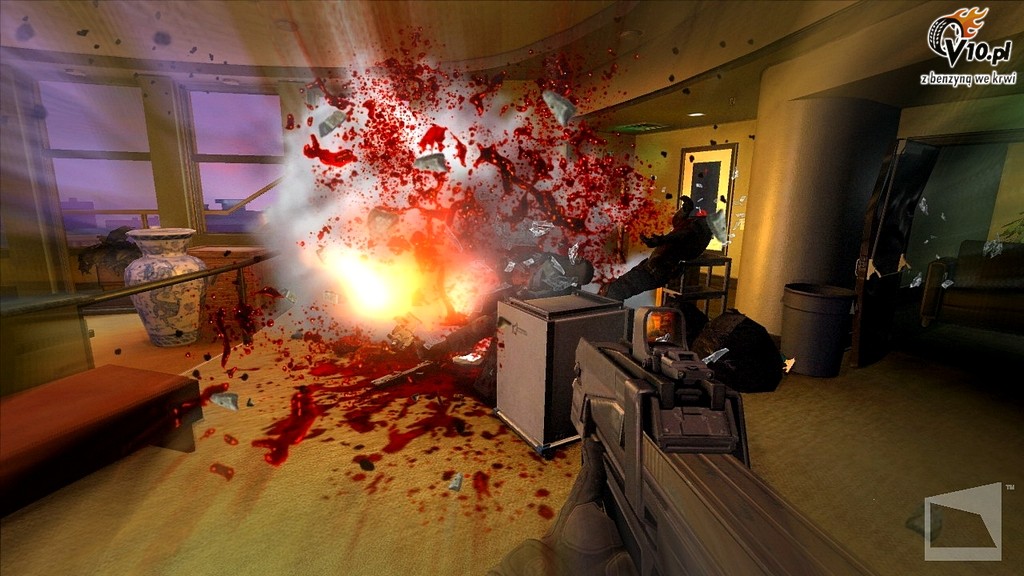 |
| OH DEAR... |
This is an amazing feat particularly when there is nothing in FEAR 2 that strikes me as unconventional of the genre. We have seen the same settings: deserted offices, apocalyptic urban environments and dark pipe lined sewer tunnels in hundreds of other games, the first FEAR being a good example in itself. We have seen the same mechanics, a slow motion bullet-time ability that gives you an edge over your enemies. We have fought against the same enemies, a faceless mercenary bunch and the odd monster or two. What makes FEAR2 brilliant is its combat, its frenetic and visceral fire fights. The developer clearly realise which elements go into a great shooter. The guns all feel powerful, there is a technique to using each. The enemies are controlled by a decent AI system, which has them run for cover and throw grenades. On hard difficulty, these enemies pose a significant challenge and you constantly feel blessed when you have the ability to go slo-mo and see each of your shots landing. Killing said enemies is a gory business particularly if you fire a shotgun at close range for example. Then there are the environments, which all react realistically in the middle of a fire fight. Glass shatters, paper flies, and bullet holes puncture the walls. Of course when guns fail there is possibly no better feeling than roundhouse kicking a guy to the face.
The game is let down by the horror elements which try in earnest to scare you at every possible moment. The game is called FEAR, so I guess the developers thought that this is the direction they were supposed to go in but it is all so woefully contrived. I paid no attention to the plot or the various bits of information you pick up throughout the game, but you are followed by Alma, a supernatural entity that is basically the girl from the Ring. Essentially she covets you, messes with your mind, floating objects in front of you, whilst killing off other people for the sheer hell of it. Sometimes she grabs you from out of nowhere and you have to rapidly press the B button just to get her off. Along with Alma, you will also be tasked with fighting off other supernatural entities including puppet master beings who bring the corpses of the dead to life and ghost like beings that are almost invisible save from the faint flicker of their form. Fighting these enemies offers a different experience but is nowhere near as good as fighting the generic soldiers.
In conclusion, FEAR 2 offers a challenging and engaging shooter experience, that works brilliantly at conveying John Woo style shoot outs. It caught me completely by surprise and easily stands up against Halo, Modern Warfare and Killzone 2 in the heavily populated FPS arena. Combat is satisfying and endlessly replayable. It is let down only by the tacked on 'horror' sequences but I'd still recommend any shooter fan to check this game out.
50 Cent’s Blood on the Sand
 |
| Mr Cent shows the US Army how its really done. |
I rented this game after laughing about it and then hearing several favourable reviews. I am no fan of 50 Cent's music, and the game didn't make me any more partial. I am white, with a capital ‘why’. In fact what I ended up doing was playing classical music through my xbox hard drive and thusly playing the game accompanied by Canon in D minor.
50 Cent: Blood on the Sand is a third person shooter starring Mr 50 Cent, various members of G-unit and even Lance Reddick from Lost and The Wire! The game takes place in some anonymous war torn middle eastern country, where 50 is performing a gig through which he is paid by means of a priceless diamond encrusted skull. Of course things do not run smoothly, 50 is ambushed, and some strange woman runs off with his skull, to which 50 responds with the immortal line - 'Bitch stole my skull!' This puts in motion an epic quest through city streets, and ancient ruins fighting off waves and waves of bad guys and no less than five helicopter gunship boss fights.
As a third person shooter the game works remarkably well. Shooting is satisfying and addictive as the game throws many mini-challenges throughout each of the levels, boosting your score. The game is let down by a dodgy cover system which often feels transparent to bullets and perhaps a lack of commitment to the cause. The game’s saving grace is that it does not take itself seriously, the game is so obviously tongue in cheek. Seeing 50 cent finish a bandanna wearing bad guy with a knife to the chest is hilarious rather than grim. 50 Cent and his accompanying G-unit sidekick fire off various insults (insults you can UNLOCK through points!) whilst spewing out all the conventional military verbatum. You begin to wonder where 50 Cent and G-unit received all this military training. Life on the streets must have been tough, and though Mr Cent was famously shot nine times you still question his involvement in Middle Eastern affairs.
In conclusion, this game is well worth a rental at least. It has co-op so you can enjoy the gangsta rap lunacy of it all with a friend and a degree of replayablility as you rack up more and more ‘ice’ to get the gold medal for each level. It pushes all the right buttons and if you do actually like 50 Cent then this will probably be the best game ever made.
Dante’s Inferno
 |
| I'm absolving him. Honest... |
In keeping with the winning formula of God of War series, Dante's Inferno seeks to emulate a piece of classical literature through ultra violence and minor titillation. Visceral Games, the makers of Dantes’ Inferno also made Dead Space, which used the conventional survival horror formula to great effect and actually bettered Resident Evil 5. Unfortunately, in emulating the God of War formula, playing Dante's Inferno only reminds you how good those games were in comparison. It isn’t just the combat and the green health orbs, the entire story is told in the exact same way as the original God of War. Of course what Dante’s Inferno also adds to the mix is actual shit. Not just through shoddy level and tasteless monster design but some of the enemies do actually attack you with their own excrement...
In a nutshell, you play as Dante, a knight fighting through the crusades, who may or may not be guilty of one or two of the seven deadly sins. His beloved Beatrice is killed and taken to hell, thus Dante must battle through the nine circles of Hell and come out on top against serial wanker Lucifer. You are made to fight various monsters and demons ranging from the usual undead footsoldiers, siren like entities that shoot scythed tentacles out of their vaginas and these gluttonous worms that are essentially penises with teeth, a concept which people are naturally supposed to find fearful at a deep psychological level. The boss for the lust level also produces attack babies out of her breasts. Yeah, it is that kind of game... Dante’s Inferno’s problem is that it tries too hard to shock the player. Whilst God of War is violent in a gleeful way, Dante’s Inferno just tries too hard. In attempt to deepen the combat, Dante’s Inferno gives the player the choice over whether to punish or absolve your enemies. The former being the way to the dark side whilst the latter is effectively a stairway to heaven, giving you points which unlock more powerful moves. Ramping up the difficulty only increases the amount of hits it takes to bring down an enemy. Effectively, the various demons begin to feel like super absorbent sponges rather than an actual challenge.
Though rated as an 18, Dante's Inferno feels inherently juvenile. If there is a hell, it is probably being made to play Dante's Inferno for all eternity. There are so many better God of War clones to play now. If the God of War trilogy didn’t satisfy you, there is Wolverine’s Revenge, Force Unleashed and the actually really good Darksiders by Vigil games. I’ve talked too much about this game. Let’s talk about something else...
Sunday, 13 June 2010
Tom Clancy's Splinter Cell: Conviction
* SPOILERS AHOY!!!

"Huzzah!!!"
The subtle art of not being seen is one of the hallmarks of the stealth 'em up genre, a genre whose creation is usually accredited to Hideo Kojima's Metal Gear series. Popularised by the release of Metal Gear Solid on the PSone in the late Nineties, the stealth 'em up offered a different style of gameplay to the 'overkill' mentality that has and continued to characterise a large slab of the gaming market. It required a different approach, a degree of strategy and patience, and rewarded the player with a sense of satisfaction after a successful infiltration. The problem, specifically with the Metal Gear series, was the overbalanced ratio that the player experienced between actually playing the game and watching it through lengthy cut scenes. A year after the release of Metal Gear Solid 2 in 2002, Tom Clancy's Splinter Cell offered an alternative experience to the cinematic grandiose of Kojima's series.
Splinter Cell, put you in the sneak boots of Sam Fisher a retired super spy voiced by Michael Ironside who is called back into action for that ‘one last mission’. The stealth mechanics required the player to adopt a predatory approach to espionage, relying on hiding within the shadows and keeping noise to a minimum. Fisher was always armed with his trademark nightvision goggles that effectively turned the player into Buffalo Bill at the end of Silence of the Lambs. Whilst his enemies could not see you, you could see them giving the player an inflated sense of power. There were night vision goggles in Metal Gear, but there were also card board boxes, strategically placed softcore magazines and tranquilizer guns. Splinter Cell gave you a much more linear style of gameplay rooted in high tech gadgetry. Progressing through a mission was often a slow and highly methodical paced experience as you picked off guards one by one, hiding their bodies and tip toeing through the shadows towards your objective. The game proved successful, and a franchise was born on an annual production cycle.
With the release of Double Agent across all platforms including the newly released Xbox360 in 2005 the formula was beginning to feel stale. At least, that is what I thought, I remember sitting down to playing the game and constantly screwing up my stealth approach. I didn't feel like a superspy, I felt like a retard playing as a superspy. Admittedly this was probably the reality of the situation, but the game failed to immerse me to the extent of the first three games. I no longer had the patience for the slow methodical approach of infiltrating levels, evading mouthy guards in a constant crouched position, only to screw it all up because I wasn't hidden behind the wall. Ubisoft obviously were on a similar wavelength, it was time for Splinter Cell to receive a drastic rehaul, to be adapted for the next generation. Afterall, it had worked for Capcom with Resident Evil 4.
Splinter Cell: Conviction has been in production for almost four years. The game has experienced many delays and has gone back to the drawing board on many occasions. Early screenshots released in 2007 revealed a bearded Sam Fisher on the run, a la Harrison Ford in The Fugitive. The gameplay was drastically different to that of the previous titles, involving a more practical approach to stealth a world away from the series’ usage of gadgetry and silenced weapons. Early previews revealed an emphasis on the crowd, Sam would have to blend in with crowds to avoid enemy patrols, when he was spotted and bullets were fired, the crowd would start running for safety, obviously this was an aspect that was incorporated into Ubisoft's Assassin's Creed franchise. Ironically, the finished version of Conviction is not as drastic a change to the series as the game previewed in 2007. However, it is a leaner more fast paced game than feels more highly evolved than its predecessors.
One thing that has not changed is the overall plot, a generic paranoid conspiracy narrative that we have seen in other splinter cell games as well as other thrillers. You once again play as Sam Fisher, a man very much on the edge due to the untimely demise of his daughter that happened in the last game. At the beginning of Conviction, you are informed by a new contact that the circumstances concerning your daughter’s death may be part of a larger conspiracy and so is set in motion a new mission in which Sam is fed tidbits of information from the table as he does the government's dirty work. For all the shortcomings of the plot, the gravity given to Fisher by Michael Ironside really succeeds in humanising the character despite his obvious imperfections as a man with the fitness and flexibility of a twenty year old though the physical appearance of a forty year old man and the voice of a sixty year old man, Sam Fisher is at least a genuine character who is worth rooting for unlike that annoying prick you play as in Just Cause 2.
However, the real strength of Conviction undoubtedly lies within its execution, both in the plot and the gameplay. Whilst Uncharted 2 was essentially an interactive action comedy experience in the vein of Indiana Jones, the latest Splinter Cell serves up an interactive version of a slick 24/Bourne esque thriller. Unlike Metal Gear Solid 4, essentially five levels padded out with hours of cut scenes; Conviction succeeds in completely immersing the player within the story as it happens, rarely taking the level of interactivity from out of the player's hands. There is no checking your PDA for your latest mission objectives; instead they are boldly displayed within the game world. Rather than deviating from the flow of the narrative, flashback sequences are projected through grainy filters onto the walls of corridors. The game’s plot is developed through a wealth of interrogation scenes, where you are forced to retrieve information from an unsavoury character through lashings of the old ultra violence. These scenes are characteristically brutal and also humorous in that they involve little to the imagination. Controlling Fisher, you hold the bad guy by the throat and will be confined to move around a small area with several objects that you can interact with. When you see a big plasma screen you know it is just waiting to be busted in by some goon's head. All these little changes keep the narrative of the game extremely streamlined and focused within the pacing of the game itself. The player is always moving forward with a clear mind with what he or she has to do next.
Splinter Cell, put you in the sneak boots of Sam Fisher a retired super spy voiced by Michael Ironside who is called back into action for that ‘one last mission’. The stealth mechanics required the player to adopt a predatory approach to espionage, relying on hiding within the shadows and keeping noise to a minimum. Fisher was always armed with his trademark nightvision goggles that effectively turned the player into Buffalo Bill at the end of Silence of the Lambs. Whilst his enemies could not see you, you could see them giving the player an inflated sense of power. There were night vision goggles in Metal Gear, but there were also card board boxes, strategically placed softcore magazines and tranquilizer guns. Splinter Cell gave you a much more linear style of gameplay rooted in high tech gadgetry. Progressing through a mission was often a slow and highly methodical paced experience as you picked off guards one by one, hiding their bodies and tip toeing through the shadows towards your objective. The game proved successful, and a franchise was born on an annual production cycle.
With the release of Double Agent across all platforms including the newly released Xbox360 in 2005 the formula was beginning to feel stale. At least, that is what I thought, I remember sitting down to playing the game and constantly screwing up my stealth approach. I didn't feel like a superspy, I felt like a retard playing as a superspy. Admittedly this was probably the reality of the situation, but the game failed to immerse me to the extent of the first three games. I no longer had the patience for the slow methodical approach of infiltrating levels, evading mouthy guards in a constant crouched position, only to screw it all up because I wasn't hidden behind the wall. Ubisoft obviously were on a similar wavelength, it was time for Splinter Cell to receive a drastic rehaul, to be adapted for the next generation. Afterall, it had worked for Capcom with Resident Evil 4.
Splinter Cell: Conviction has been in production for almost four years. The game has experienced many delays and has gone back to the drawing board on many occasions. Early screenshots released in 2007 revealed a bearded Sam Fisher on the run, a la Harrison Ford in The Fugitive. The gameplay was drastically different to that of the previous titles, involving a more practical approach to stealth a world away from the series’ usage of gadgetry and silenced weapons. Early previews revealed an emphasis on the crowd, Sam would have to blend in with crowds to avoid enemy patrols, when he was spotted and bullets were fired, the crowd would start running for safety, obviously this was an aspect that was incorporated into Ubisoft's Assassin's Creed franchise. Ironically, the finished version of Conviction is not as drastic a change to the series as the game previewed in 2007. However, it is a leaner more fast paced game than feels more highly evolved than its predecessors.
One thing that has not changed is the overall plot, a generic paranoid conspiracy narrative that we have seen in other splinter cell games as well as other thrillers. You once again play as Sam Fisher, a man very much on the edge due to the untimely demise of his daughter that happened in the last game. At the beginning of Conviction, you are informed by a new contact that the circumstances concerning your daughter’s death may be part of a larger conspiracy and so is set in motion a new mission in which Sam is fed tidbits of information from the table as he does the government's dirty work. For all the shortcomings of the plot, the gravity given to Fisher by Michael Ironside really succeeds in humanising the character despite his obvious imperfections as a man with the fitness and flexibility of a twenty year old though the physical appearance of a forty year old man and the voice of a sixty year old man, Sam Fisher is at least a genuine character who is worth rooting for unlike that annoying prick you play as in Just Cause 2.
However, the real strength of Conviction undoubtedly lies within its execution, both in the plot and the gameplay. Whilst Uncharted 2 was essentially an interactive action comedy experience in the vein of Indiana Jones, the latest Splinter Cell serves up an interactive version of a slick 24/Bourne esque thriller. Unlike Metal Gear Solid 4, essentially five levels padded out with hours of cut scenes; Conviction succeeds in completely immersing the player within the story as it happens, rarely taking the level of interactivity from out of the player's hands. There is no checking your PDA for your latest mission objectives; instead they are boldly displayed within the game world. Rather than deviating from the flow of the narrative, flashback sequences are projected through grainy filters onto the walls of corridors. The game’s plot is developed through a wealth of interrogation scenes, where you are forced to retrieve information from an unsavoury character through lashings of the old ultra violence. These scenes are characteristically brutal and also humorous in that they involve little to the imagination. Controlling Fisher, you hold the bad guy by the throat and will be confined to move around a small area with several objects that you can interact with. When you see a big plasma screen you know it is just waiting to be busted in by some goon's head. All these little changes keep the narrative of the game extremely streamlined and focused within the pacing of the game itself. The player is always moving forward with a clear mind with what he or she has to do next.
This dynamic pacing extends into the gameplay as well. Conviction embraces current trends in gaming, such as cover based combat and close range one button knockouts. Whilst previous Splinter Cells relied on a methodical approach to stealth, Conviction has mostly sacrificed that for a more bombastic approach that thrives on how quickly you clear an area of bad guys. Though you will still very much be moving around in a crouched position, seeking the protection of darkness and cover; dispatching guards is fast, efficient and brutal, the silenced pistol essentially becoming an extension of Sam’s fists. More than ever you realise just how much a badass Sam Fisher really is. Heads and lights can be easily taken out safely from cover, there is no delay between pulling the trigger and popping out of cover to aim, like in Gears of War for example. You just point the crosshair in the right direction and Sam just makes the shot, it is all so efficient and easy. Added to this new found slickness in combat is the mark and execute mechanic. This takes the mechanic as seen in the Rainbow Six Vegas games, where you will prioritise targets for your team mates to kill by marking them with a touch of the back button. By despatching a guard in close combat you gain the ability to execute, by pressing the y-button you dispose of each of the targets with a perfect head shot. On paper, this may make the game sound easier or at least take away the satisfaction of performing a perfect head shot with manual aiming. Not so. Each weapon has a set amount of marks. I preferred the five-seven pistol, which gives you four marks. I remember there was one room with about five guards, I marked the four guards furthest away from me and walked into plain sight to take down the fifth guard in close combat. This alerted the guards but I had earned my ability to execute, and so with a four presses of the y-button I cleared the entire room in a manner of seconds. Incredibly satisfying.
There will be times when you get spotted of course. Times like these usually see you going loud. As well as his pistol, Sam will be armed with a main weapon, a shotgun or an assault rifle for example. But these prolonged firefights are ill advised. It does not take very many bullets to kill Sam and quite often when faced with these situations you are dead. It really forces the player to adopt the stealth panther approach. Should you be spotted you can use various grenades you pick up to make a speedy get away. Though heaven forbid you confuse the throw grenade button with the reload button and unleash an EMP pulse before you plan your attack, which literally harbours all the subtlety of the world’s most malevolent fart. Yes children, to reload you click in the left analogue stick not the ‘x’ button. Though I imagine you can probably change that in the controller layout.
My main discrepancies with the game do not seriously hinder the gaming experience overall. Upon entering a new location you begin to plan your attack in a manner that evokes early Metal Gear Solid, where each area is a puzzle. This illusion is spoiled when you realise that there is a climbable pipe in the corner and maybe a precariously positioned piece of scenery that screams to be brought crashing to the ground by a single bullet as it hangs dangerously above a group of guards all met in the same place, probably discussing whether or not they liked the ending of Lost. On the subject of your adversaries, the AI of the enemies feels stuck in the past. They will notice dead bodies, shine torches in the absence of light, sometimes act startled to the sound of disturbance, and sometimes they’ll even get the better of you. Most of the time however they effectively serve as walking talking headshot receptacles. They also talk a lot, in fact they will not stop talking. They talk in the familiar unsympathetic tones of the overtly masculine jock strap who seeks only to further his own masculinity by killing you. Obviously, we aren’t supposed to be rooting for these guys and taking them down is made all the more satisfying when Sam figuratively castrates them with one of his brutal finishing moves. But still, it begs the question, just where did the government get these bunch of cretins from? Why can’t they stay silent when they know a super spy is coming their way? What happened to all that military sign language? Wouldn’t silence give them at least an air of menace?
Eventually, the game pits you against various goggle wearing peeps who effectively serve as visions of a younger Sam Fisher that appeared in previous games. Yet they just can’t do subtle. Mostly these guys announce their arrival in the noisiest way possible either by smashing through glass or using smoke grenades and flashbangs. The guards from Metal Gear never did this. They didn’t talk, they just had the red exclamation mark when they saw you, maybe a deep seated suspicion of boxes. At least the bloody FROG guards from MGS4 attempted to create an illusion of fear through their tortured screaming. When training up Fisher, Third Echelon seemed to have got it right. He remains silent in the act of killing, or at least charmingly suave as he gets an enemy by a chokehold.
Then there is the plot. There are memorable moments, such as the section proceeding a key revelatory scene in which Sam becomes aware of what has actually been going on, breaking out of Third Echelon in the vivid colours of an adrenaline induced burst of rage. Another is a particularly inspired chase scene at the Washington Monument. There are points when the game’s narrative doesn’t work so well. For instance, the game includes a fairly uninspired Iraqi flashback that essentially plays like a poor man’s ghost recon. Which I guess is no big thing, its not like these two franchises are linked to one another in any particular way...
Then we come to the whole dilemma surrounding Sam’s dead daughter. At the beginning of the game, we are reintroduced to the game’s emphasis on darkness through a flashback between a younger Fisher and his daughter, as he teaches his young daughter not to fear the dark. I thought the game would have more of these scenes, strengthening Sam’s relationship with his daughter over time, in a similar way to the original God of War, which gradually revealed the tragic history of Kratos the further you ventured through the game. But I guess that would have only worked up to a point, namely the point when you find that Sam’s daughter, the one you thought dead, isn’t actually dead at all. It feels like a cheapened resolution, I signed up to this game, thinking we were getting a vengeful fuelled version of Sam Fisher, a man on the edge with nothing to lose, a loose canon firing on anybody stupid enough to cross him. This was the ideology that Double Agent was based on, and the plot was the only thing which that game had going for itself. But hey, for fulfilling the fantasy of being a super spy, you’re not really playing the game for the story.
Aside from the main campaign, there is also the co-op multiplayer which serves as a prequel to the events of the single player. Splinter Cell has always managed to do multiplayer well. First introduced in the second game Pandora’s Tomorrow was the spies versus merc mode, which had two players tasked with infiltrating a base whilst the other two defended the objective. The spies played from the conventional third person view, possessing all the acrobatic abilities of Fisher whilst the mercs were limited to a first person perspective. It was a completely original take on multiplayer. Since Co-op seems to be all the rage at the moment, I am pleased to report that the developers have put as much time into crafting the multiplayer as they have with the single player. Resident Evil 5 should take note. For all the changes made to the Splinter Cell formula it all works incredibly well in co-op, in fact I’d go to say that the multiplayer attachment is worth the full price of the game alone, far more enjoyable as the single player. You and a friend assume the roles of Archer and Kestrel, an unlikely partnership between the US and Russia who are tasked with tracking down a couple of EMPs that have annoyingly gone walkabout. My experience was a bit like the odd couple, I was the cold calculating one carefully taking out guards silently whilst my friend preferred to kick down all doors and go in all guns blazing with a boomstick. Despite my organised approach, I would always risk my own neck when I was inevitably tasked with reviving with my magic defibrillators of curing. Messing about aside, there comes the time following several failed attempts when both of you knuckle down and decide to take the level down as a team, and when this happen the game soars. Aside from the co-op story, the game ensures replayability by various different game modes from a Gears of War styled horde mode and a conventional deathmatch mode.
In conclusion, Splinter Cell: Conviction is an excellent rejuvenation of the series. Some die- hard fans may mournfully recall the old times which allowed for a more organised approach, but for me personally I think the changes to the game revitalise the series and the genre as a hole. In the wake of Metal Gear Solid 4 especially, the fifth Splinter Cell game provides a far more linear approach to the stealth ‘em up genre that rarely sacrifices time spent playing the game against watching the plot unfold. As much as I love the Metal Gear Solid series, Conviction is more efficient as an interactive experience. Given the choice between watching the latest thriller at the cinema or playing Conviction alone or with a friend, I know exactly which experience I would choose.
<!--[if !supportLineBreakNewLine]--> <!--[endif]-->
Subscribe to:
Posts (Atom)