Thursday, 31 March 2011

Crysis 2 - Suits you sir...

Platform: Xbox360, PS3, and PC
Certificate: 15
Developers: Crytek
Publishers: EA
Genre: Sci-Fi FPS

I know what your thinking: "Dat ass"
With Crysis 2 being the next in a long line of first person shooters to arrive this year after Bulletstorm, Killzone 3, and Homefront there is an added emphasis on genre titles having to define themselves in an increasingly crowded market. Fortunately Crysis 2 rises to the challenge by offering players an alternative to the highly scripted linear nature of your modern warfare clones through expansive environments and a veritable restaurant menu of different tactical approaches to pursue depending on where the mood takes you. It also looks very pretty…

The original Crysis released in 2007 was a PC game proud and true. Effectively a spiritual sequel to 2003’s Farcry developers Crytek’s first tropical island shooter, Crysis had the kind of graphics that would make a deity weep creating the most realistic and expansive jungles that only the most high spec machines could muster. It was so good looking that its competency as an FPS was largely overshadowed, introducing us to the performance enhancing Nano suit and weapon customization back before COD4 had made it FPS verbatim. It wasn’t without its flaws in regards to accessibility but Crysis introduced an intriguing tactical dynamic to the whole one man against an entire army shtick. It also had aliens of course. Don’t forget the aliens.
   
Crysis 2 is set within New York City in the year 2023, three years after the events of the original Crysis. The alien race known as the Ceph, which were introduced in the first game are invading Manhattan Island unleashing a deadly plague on the people. With the city under martial law, you are put in control of a US Marine known only as Alcatraz; you are being deployed into the city via submarine to escort an important scientist by the name of Gould out of the city. Things do not go swimmingly of course, or they do seeing as you are quickly forced to escape your submarine which is suddenly attacked. After a brief and slightly haphazard introduction with one of the alien war machines, you are pulled out of the water barely alive by returning super soldier Prophet, who wears the all important nano suit. Blacking out, you regain consciousness the next day, for some reason Prophet lies dead on the floor with you encased in his nanosuit. Thusly, you are sent into the fray, using your suits body enhancing features as the man most capable of bringing an end to the alien menace. Aliens are not your only cause of concern of course, CryNet, the developers of your performance enhancing suit are looking to regain their technology by any means necessary, and have dispatched an army of PMCs to take you down, saving the world becomes more complicated…

Shabba!
Crysis 2 may look like another sci-fi shooter existing somewhere in between the vivid colours of Halo and the oppressive bleakness of the Killzone series, but as the game begins introducing its fundamental concepts you realize that you have an added element of choice into how you want to get your war on. Dropping the tropical island of the first game (and Farcry for that matter) Crysis 2 is set in the urban jungle of Manhattan, but if you thought this would make the game more linear you would be wrong. As I have said in the opening, one of the main appeals of Crysis 2 over its many contemporaries is a sense of openness and freedom of player choice. Throughout the lengthy campaign you will be fighting through the city’s deserted war torn streets and there will be numerous different routes available to you, some obvious and some which may require a bit of exploring. Admittedly there are sections where you are forced to crawl through corridors and tight spaces, like the obligatory sewer sequence but for the most part the game places you in large open areas, which often or not will call for a degree of planning. Whether it be meticulous planning of made up as you go along.

As with the first game, the nano suit is a vital component to combat that grants the player this extra freedom. But whilst Crysis only allowed you the rather limited option of switching in between the four powers of speed, strength, armour and stealth, Crysis 2 greatly refines the interface making it far more accessible and efficient to use. Speed and strength function latently into the way you move, you can sprint by clicking in the analogue stick, you can jump high by pressing the ‘A’ button and you can pick up heavy objects at will and throw them at your enemies. The game feels very much like Mirror’s Edge or crackdown as you traverse areas, vaulting onto objects and sliding through crawlspaces. The two shoulder buttons control stealth and armour mode, the former activating a predator style invisibility cloak and the latter making you more resistant to damage. All abilities consume your suits energy which will recharge with time, though thankfully far quicker than in the first game. There is also a vague leveling up system, for each of your powers there are three types of focus. You can unlock the ability to dampen your footsteps or identify gunfire tracers. Then there is the coup de grâce, the air stomp, which allows you to smash down upon your enemies from the skies. It doesn’t happen very often and it can be very difficult to pull off, but when you do it is tremendously gratifying, even if it does usually leave you prone to enemy fire and shot to pieces in mere seconds.

The suit also grants you different vision modes, a thermal mode allows you to see in the dark and identify hidden targets through their body heat, predator style. Then there is the particularly useful tactical mode, which allows you to mark enemy targets, and identify weapon supplies. It will also advice you on how to approach an area, for instance in one large area, the tactical visor will identify turrets, or routes that are prime for flanking, exploring and using stealth. These are never orders just advisory tactical maneuvers that beckon you into embracing the game’s open ended style of play.
 
Most times I was opting for the stealthy approach. Observing my situation candidly, seeking higher ground marking all the targets, watching their patrol routes before picking them off one by one with silenced head shots or stealth attacks. Of course, you can go in all guns blazing, coupled with the game’s large environments and nanosuit functions, you will rarely get overwhelmed as you can retreat by gaining high ground or maybe ducking into a subterranean sewer. Of course, the humanitarian gamer can play through some sections without killing anyone if they so wish. In some areas you will be able to sneak your way around without firing a single bullet.

The stealthy approach.
The enemies in Crysis 2, come in the human PMC variety and of course the alien Ceph variety. Whilst the enemy AI, does not seem to be as cunning as the Korean soldiers of the first game (who we can presume went off to invade the US in Homefront) it is at least competent in putting you through your paces. If you are detected they will send up flares calling for reinforcements. They will run for cover and try to flush you out with grenades. The aliens on the other hand are a lot more offensive and in your face. In the first Crysis, the Ceph were characterized by Matrix styled hunter killer robots or War of the Worlds styled tripod fighting machines, they have been given more conventional makeover for the sequel now appearing in humanoid form. Part robot, part space squid they bare an almost uncanny resemblance to the elites and hunters from Halo. Head shotting them will similarly send orange fruit smoothy gushing at explosively velocity all over the place, which is admittedly very satisfying and gleefully b-movie. Whilst the PMCs are fairly limited on where they can go, the aliens will be jumping to higher ground and charging at you and pursue you relentlessly. They are also capable of turning your suit against you, unleashing EMP bursts that will knockout your suit’s power making you extremely vunerable and a prime candidate for an alien spit roast.

The game contains the usual arsenal of pistols, shotguns and assault rifles, with a couple of colourful new inventions such as personal favourite X-43 MIKE (or the Microwave Incendiary Klystron Emitter as it is technically known children) which is perfect for frying the malevolent forces of the cyborg space calamari to combustion point. There is once again in line with the previous game more dimension to combat as you adorn your weapons with all the usual attachments relevant to your tactical situation. Add a silencer, a scope and a semi auto switch and you’ll be best suited to the role of stealth marksman. Alternatively, equipping a heavy machine gun with a laser sight will make you better equipped from firing from the hip. Whichever situation you opt for, Crysis 2 plays well regardless. After being stealthy during in one section, it was almost cathartic going loud to battle aliens through a storm drain. Once again, Crysis 2 gives you more freedom over how you approach your situation, at least farm more than most of its contemporaries (it isn’t Bulletstorm). It also gives the game great replay value. I did enjoy the game on the first time through, but I did feel slightly limited in places because I hadn’t unlocked some of the all important attachments. The early stages of the game is very difficult without a silencer for instance. On my second time through, I had access to all my kit and could even play it on the hardest setting and the game was even more enjoyable, as I could replay the sandbox zones in different ways.

Apart from the usual foot soldiers, Crysis 2 will occasionally throw bosses at you, be it tanks and helicopter gunships on the human side, or large brutish gladiators and tripod walkers on the alien side. The campaign is very lengthy, and whilst the enemy design is decent if a little bit formulaic, there really isn’t much in the way of variation. There are no colossal boss fights or standout moments as in the Playstation’s Resistance series or Gears of War, which is certainly a crying shame. It would have made the game all the more memorable if you had to face off against one off creatures that required a different attack plan from the usual sandboxes.

Now may be a good time to put the old invisibility cloak on.
This isn’t to say that the campaign is bereft of standout moments be it linear or emergent. The linear moments usually involve something to do with the environment, at one point for example a Day After Tomorrow tidal wave inexplicably races down the street you are travelling. Other than this there are plenty of times when giant skyscrapers are falling down around you or enemy vehicles career into the side of the building you happen to be sitting. As for emergent gameplay, Crysis 2 shine. In one of the game’s final levels, I actually managed to sneak my way through an alien infested outpost. This led to an incredibly tense gaming session, with my suit’s power forever draining with enemies literally patrolling around every corner, reactionary to the smallest sound, it certainly beat all the normal scripted events throughout the course of the campaign.

The main disappointment of Crysis 2 is undoubtedly the story, unfortunately reared from the stable of generic action game fluff. It is not that the game is badly written, incidentally by dystopian novelist Richard Morgan (author of the Takeshi Kovacs series)or even badly acted, it is just painfully generic. For all the detail put into the graphics and surroundings of New York City, you never get a full sense of the extent of the disease on the ordinary people. You will come across a lot of survivors suffering from the disease, huddled, sick and dying in the subway stations and apartment blocks with these awful alien growths attached to their body. I was half expecting that they would become feral zombies, giving me something else to shoot after facing the organized militant forces of the game, but alas it never happens. There is no interaction with these characters, save for their frantic speech and mumblings, you can’t even shoot them and put them out of their misery. It all feels slightly distant.

Then there are the aliens themselves, who are just there. There is no build up or explanation as to where they come from and why they are here on earth in New York of all places melting perfectly decent human folks into organic soup. There are grisly hints here and there or course, the game does do atmosphere very well. The opening of the game has you negotiate through Central Park, which has acted as an evacuation zone. You go through medical tents, turnstiles and deserted queuing areas, going past mounds of body bags and the like. The game making use of all the eerie post 9/11 imagery, ransacked and deserted streets, walls littered with missing person notices and the dust clouds from toppled buildings. Even though you are fighting on American soil, there is little of that American bravado that characterizes so many other games. One of the best moments of the game occurs at night, when you are called to assist the marines to hold back the aliens as you evacuate people from Grand Central train station. It is here that you get a sense of a bigger story. Other than that, the story never seems to contextualize or give any substance to the alien attack. It is always more concerned with the suit that your hapless character is encased within.

Perhaps this is the point. Your character’s name is Alcatraz after all, and you are effectively imprisoned within this advanced technological super suit against your own will by Prophet, isolated as if on an island as the only one equipped to save the human race. Then there is the added dimension of Manhattan acting as a kind of prison on an island as it plays host to an alien invasion and viral epidemic. This all makes good thematic sense, a solid base for any story to be founded upon but it never happens. As Alcatraz you mission objectives are given by a variety of talking heads, one of which is the obligatory hippy scientist wanting you to gather alien samples. The next is the shadowy force at the head Cry Net who developed the suit you are wearing and obviously knows a lot more than he lets on. Then there is the obligatory hard as nails military chick who will give you orders to follow, the grunt you are. Seeing as you are the one wearing the suit, and taking into account the nature of the gameplay itself, you would think you would be capable of making your own decisions on who to trust. Perhaps this is asking too much from an FPS. Maybe next generation. Regardless, the narrative arc goes through familiar territory, as you fight through the latter stages of the game you’ll have to bear people talking through your ears telling you how flawed and feeble the human race are and how futile and inconsequential your escalating third act heroics really are in the grand scheme of things. It can sometimes really grate on even the most spectacular sequences that occur during the latter stages of the game. It is a great shame really, because everything about Crysis 2 is top of the line, but it is the story that stops it from being a stone cold classic, falling way short of Halo: Reach or COD4 and of course Half Life 2.
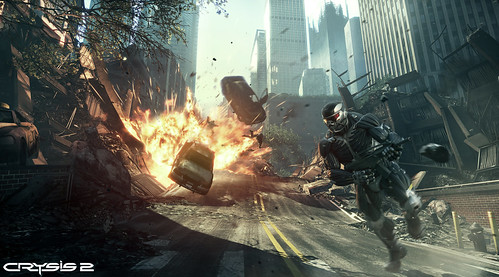
Why is it always the Big Apple?
 Which of course brings us to the graphics. Crysis was famous for its system hogging visuals synonymous for hardcore PC gaming. I only got to play Crysis for the first time last summer, when time had forced me to update my desktop. Supposedly Crysis 2 is more lenient on PC specs than its predecessor, suffice it to say Crysis 2 still looks absolutely amazing. There aren’t enough adjectives in English language to convey how good it looks or how well it runs. Even on the humble xbox there was little in the way of frame rate issues and runs like a dream. I perhaps wouldn’t go as far to say that Crysis 2 is the best looking game on the market. I would say that it is at least on a par with Killzone 3 on the Playstation but it is definitely in the upper echelons and considering how open ended the game is it is amazing feat on the part of Crytek, particularly when you are used to seeing such high polished sheen in the more linear FPSs like the latest COD games.

The artistic direction is all there to make full use of the latest incarnation of the Cry Engine, at times as you negotiate the streets of New York, the game feels photorealistic. It may only be the odd soldier animation that will put you off. Sometimes enemies will get stuck in walls and remain walking on the spot, there are a couple of AI glitches and some graphical pop in issues but nothing too serious to break the game. The environments themselves are oddly beautiful, burst drain pipes lead to urban rivers, running over chipped concrete and cascading as waterfalls over craters housing the remains of a doomed dropship all under the red glow of the setting sun. It sounds like pretentious poetic waffle, but this is what the game looks like and it is quite simply a joy to behold. Nothing short of a feat of graphical wizardry. I found myself drawing a lot of comparison’s to Bulletstorm which came out a couple of weeks ago. Both games have sections that force you to play through dilapidated buildings that lie effectively on their side, but Crysis 2’s depiction of Manhattan just puts Bulletstorm’s failed resort utopia weep.

In addition to the campaign there is also a versatile multiplayer mode. Which is in line with the parameters set by the Call of Duty MP experience. The suit becomes as big an element to the experience as it did in the single player, allowing you a choice of several classes before giving you the opportunity to create your own class. The normal death matches quickly become tiresome, as you are time and time again shot in the back or spawn killed by somebody in stealth mode, but the objective team based games are where the multiplayer really gets going. One decent innovation is lifted from Battlefield: Bad Company 2 where you’ll remember whenever you knifed an opponent you would gain the extra satisfaction by prizing the player’s dog tags from their cold dead hands. Crysis 2 adopts this quirk, whenever you drop another player, he’ll in turn drop a dog tag for collection. Attainment of dog tags grants you access to the usual killstreaks. It is a neat innovation, as it prevents long distance campers from racking up killstreaks. Plus, whenever you kill an opponent, the impetus is on you to retrieve his tag which will go against defensive styles of play. Corridors and lines of sight become increasingly important because even if it looks that no one is there, you can never be too sure.

The multiplayer is serviceable, in my opinion it’s not quite as good as Killzone 3 and it doesn’t have that degree of variation and randomness that Halo has, but it makes for a fun distraction from the single player campaign, which you will want to play a couple of times anyway. I did find some issues with matchmaking, it is not as efficient as either Halo Reach or Black Ops and there can be some annoying bugs in regards to hit detection. If you get a group of friends online, I’m sure it will be far more enjoyable as the gameplay allows for more co-operation through communication. Indeed, you are left thinking that a co-op mode of some form is missing, but perhaps this would be too taxing on the engine.
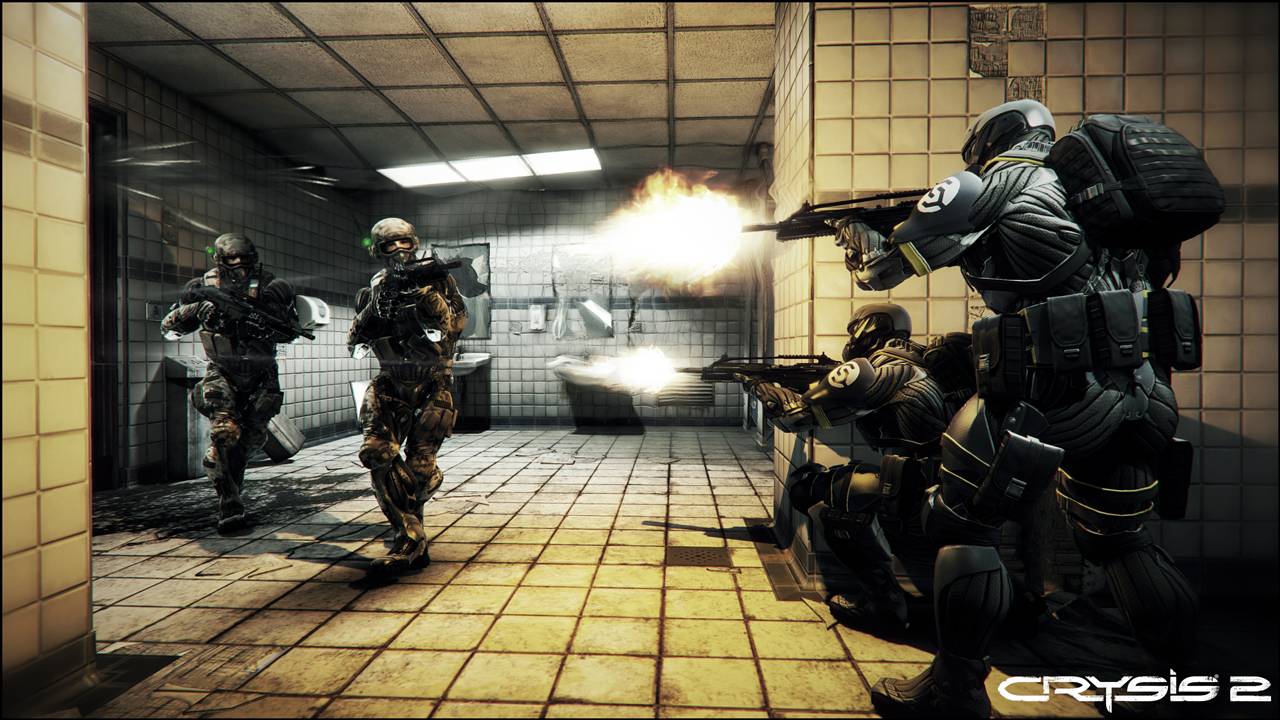
Bathroom assault.
With that said, Crysis 2 is a great package as it stands. Though some jaded PC gamers may feel like Crytek have sold their soul by developing for consoles, Crysis 2 improves on the formula established by the first Crysis. The gameplay has been refined and made all the more accessible, from the nano suit to the open but confined city environments and it all plays remarkably well on the controller. The surprisingly lengthy single player campaign is worthy of replay thanks to the variety of options the game offers you. It is let down by a generic story and a lack of variation in enemies which doesn’t do the game’s stellar presentation values, be it the fully blown orchestral soundtrack to the awe inspiring depiction of apocalyptic Manhattan island any favours. Whilst the MP allows players to find further uses for the nano suit, and does manage to retain the game’s sheen it does feel too much like an add on to keep its contemporaries from laughing at it. Those who are getting well worn by the linearity of many a corridor shooter will find the open ended tactical feel very refreshing and also, the graphics are also very very nice. 
 
8/10

Sunday, 27 March 2011

Limitless - Drugs are baaad...

Director: Neil Burger
Starring: Bradley Cooper, Robert De Niro, Abbie Cornish
Certificate: 15
Duration: 105 minutes


The idea that we are sleepwalking through our lives, never fulfilling our true potential is a universal conceit and it is the intriguing premise on which techno-thriller Limitless is built. Based on the 2001 novel The Dark Fields by Alan Glynn, Limitless is stylistically speaking very sparky, but it doesn’t stop the film from suffering from being a generic thriller fused with elements of an equally conventional tale about the woes of drug use.   

Literally starting on top of the world, Eddie Mora (Bradley Cooper) stands on a balcony of his expensive apartment. Armed guards are attempting to break in and Eddie is thinking of jumping, but not before going back a couple of weeks to explain to us just how he got involved in such a precarious situation. Weeks earlier, Eddie is a struggling writer trying to come up with a first draft for his long gestating novel. Along with suffering two failed romances, he lives in a crumby apartment in New York and spends a lot of his time drinking the hours away in the nearest bar. After a chance meeting with an old acquaintance, Eddie is given a single pill of NZT-48, a new drug that supposedly increases brain activity and intelligence. Whilst the average human only uses 20% of his/her brain, this pill will allows you to have access all 100%.

With nothing to lose, Eddie takes the pill and immediately realizes he has access to the full power of his brain. He is able to finish his book in four days and learn foreign languages with ease. It isn’t long before he finds himself capable of calculating complex mathematics and algorithms which allows him to play the stock markets like a fiddle, making 2 million dollars in a week, which attracts the attention of powerful no nonsense businessman Carl Van Loon (Robert De Niro). Eddie is set for a meteoric rise to power, but he isn’t the only one reaping the benefits of this miraculous new drug and there are of course others looking for their latest fix when supply is in big demand. All of which leads him to his predicament on deciding whether he will jump or not.  

LIMITED
Limitless masquerades as a techno-thriller with all its fast talk and snappy editing, but at its heart it is a parable about the dangers of drug abuse. It is essentially Trainspotting for the kind of people who attend stylish cocktail parties and talk in depth about the world’s problems to make themselves look better. The kind of affluent people I can only assume would be well used to snorting lines of coke off a stripper’s brassier. Incidentally these are the same kind of people who the movie assumes we normal folk aspire to being.

Like Trainspotting, the movie shows the highs and lows of drug use, though never quite as impactful, this isn’t a gritty movie in any sense. Director, Neil Burger injects a hyper kinetic visual flair to proceedings that feels very similar to the style of Danny Boyle as he relives Eddie's latent memories and depicts his burgeoning intelligence in a fashion which is reminscent of Ron Howard's The Beautiful Mind, though obviously on speed. Forever zooming shots down the streets of New York are used to convey the feeling of UNLIMITATION and are used far too much, as if the director has discovered fire for the first time.    

After playing Face in the A-Team remake and starring in The Hangover and its soon to be released sequel, Limitless gives Bradley Cooper his first starring role, a movie in which he also plays a producing role. I’ll be honest, whenever I see this kind of acting/producing situation I can’t help but shake pictures of Kevin Costner’s grotesquely inflated sense of heroism in Waterworld or The Postman. You’ll remember in Waterworld, the tirade the child gives to Dennis Hopper’s bad guy about how Costner’s mariner is coming to save him because that’s just the kind of hero he is, all inter spliced with Costner’s mariner infiltrating the bad guy’s base haplessly killing every henchmen he comes across with ruthless efficiency. Then you’ll remember in the Postman, when Costner is buoyed literally on by the whims and goodwill of a post apocalyptic American society, as he soars serenely in a wicker basket zipline construct. It was all a bit too much. Luckily, Bradley Cooper doesn’t undergo any comparable delusions of grandeur but he may be well on his way, as he out acts a sleep walking Robert De Niro.

In the movie’s opening, Cooper plays a struggling writer. Typical of a Hollywood movie, the only way to present this is by having Cooper dressed as a grungey pony tailed layabout, effectively representing the ugly duckling destined for transformation into the industry’s idea of perfection. Sure enough, as Eddie takes the drug he begins to sort himself out, he cleans his apartment, he gets a haircut and starts wearing suits, he begins to look more like Bradley Cooper which is clearly the film’s idea of unbridled LIMITLESS brilliance. 

 LIMITLESSSSS
There are many glaring plot holes throughout. Laughably, Eddie gains access to the pill via his ex brother in law, who used to peddle drugs before he gained a prominent position working for a pharmaceutical company. Just let that sentence ferment. Would you be so trusting of this kind of character who offers you a sample of an unknown pill? It doesn’t matter, no pill, no film and by taking the pill soon Eddie soon discovers that he is able to draw on countless memories, all information he has absorbed in his life time no matter how big or small. Just by looking at somebody, he is able to make powerful deductions on people in a manner that is pure Sherlock Holmes. He has such great power but does nothing of worth with them, which is perhaps the most frustrating thing about the movie.

I was left underwhelmed that the height of his character's potential was getting a haircut and dressing up in a slick suit to become a demon in the stock markets and a high flier in the world of corporate business. The character isn’t ruled by making the world a better place at all, just another corporate suit looking to help Robert De Niro’s Donald Trump character make a worthwhile merger with another bloodsucking corporate swine. I mean why doesn’t Eddie use his analytical powers to look into the third world deficit and conjure up bold new approaches to tackle real world problems so we don’t have David Tennant shouting at us demanding to give money to Comic Relief. I was left asking myself, what if Albert Einstein had taken this drug, would he look as slick? Would he be tidier? Would he be looking to work the stock markets as effectively as Bradley Cooper? Or would he still be utilizing science to help better mankind’s conception of the universe. The film would probably have you belief that Einstein, for all his genius was probably on NZT-48 as well. 

Robert De Niro could do with some NZT-48, when was the last time you saw him in a good movie?
The majority of people who watch a fair amount of movies will already have developed highly attuned sense of deduction when it comes to recognizing tropes and predicting how a movie is going to play out. The twists are so easy to see coming in Limitless, the audience may think they are on NZT-48 itself. There are so many cliches within this movie, so many times in which you as the audience are shouting at the screen, you could literally make a drinking game out of it. In one moment, Eddie realises that somebody has stolen his stash from a secret compartment in his jacket we shout “I told you, you shouldn’t have relinquished your jacket to the police, your enemies are smart enough to have spies everywhere!” 

As it happens you will constantly feel you are one step ahead when watching Limitless. Perhaps this is the point, to make you feel that you are smarter than Bradley Cooper’s character. A way to give film goers a chance to feel proud even when the film loses them at the cocktail parties and speeches about foreign policy. 

Limitless is a bog standard thriller that is high on visual panache and a likable performance from Bradley Cooper. As you leave the cinema it will leave you asking what you would do if you had 100% access to your brain. I can guarantee that whatever you may think of doing, it will be ten times more interesting than what happens in this movie.  

Very LIMITED indeed. 

6/10   

Wednesday, 23 March 2011

Killzone 3 - Sign me up to the Helghast please!

Platform: PS3
Certificate: 18
Genre: FPS
Developer: Guerrilla Games
Publisher: Sony
Release Date: 23rd February 2011


Killzone 3 is the inevitable sequel to 2009’s Killzone 2, a game that had potential to be brilliant but was prey to numerous misgivings in regards to aesthetics and control. Luckily, with the third installment, Guerilla Games have improved on the formula to create a far more accessible and wholesome FPS. You may even learn to love Rico Velasquez.

The original Killzone first entered the scene back in 2004 as Sony’s answer to Halo. The game introduced us to the evil Helghast, a race of people seemingly brought up on the worst aspects of human history represented by legions of red eyed gas masked goons that were the depiction of German stormtroopers who spoke in the tones of an entire cast of demonically possessed British PE teachers. In control of a soldier of the opposing ISA forces (or the Interplanetary Strategic Alliance if you want to be technical) you had to defend your home planet from the invading forces of the Helghast somewhere in humanity’s far flung space faring future. Despite being a competent first person shooter, supposedly based upon actual World War I and II battles, Killzone was critically panned over numerous technical issues in regards to graphics and enemy AI. It didn’t stop Sony from grooming Killzone into a fully fledged franchise train. The original game was followed by third person shooter Killzone: Liberation for the PSP in 2006 and then the much hyped Killzone 2 on the PS3 in 2009.

Killzone 2 was an ambitious if highly flawed masterpiece that perhaps personified the Playstation 3 as a system. Graphically it was perhaps the best looking game on the market, boasting the raw power of Sony’s George Formby lean mean grilling machine. The firefights were visceral and draining, easily surpassing COD as the shooter most likely to instate symptoms of shellshock in the player. Developers Guerilla Games opted for an alternative approach to control, injecting a sense of heaviness and limitation when it came to movement. When it came to shooting, the thunderous recoil from the various weapons required shots to be fired with greater accuracy and in controlled short bursts. Throw in a cover system, the likes usually seen in third person shooters and a couple of questionable six axis diversions, Killzone 2 divided players. Though some liked the gritty sense of realism, others found it very inaccessible, clearly not ready for the kind of combat Guerilla Games had in mind. 

Poetry in motion?
 Such was the savage nature of the combat, the storyline and characters felt largely overshadowed.. Placed in control of ISA soldier Tomas ‘Sev’ Sevchenko, the player was part of the first wave in a counterattack against the planet Helghan. For the briefest moment in the beginning it felt as if you were going on a boy’s own adventure, as you and your squad were dropped off upon the planet’s surface. It wasn’t until the moment you got below cloud cover that you realized just what Killzone 2 had in store for you, a grueling uphill war of attrition through an oppressive industrial setting that would test the meddle of any FPS player. The game never really relished in any set pieces, save for a brief tank section, it focused wholly on the infantry firefights, between you and the Helghast, gaining ground and defending. Admittedly it did it very well.

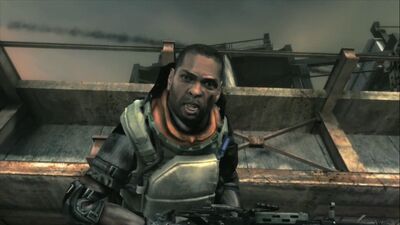
Then there was a certain Master Sergeant by the name of Rico Velasquez. Velasquez was constantly latched to you throughout the entire game as your wingman. The story dictated that your character and Rico are best buddies, but it is not an understatement to say that Rico was the most obnoxious, most infuriating, most vulgar, most wretchedly unsufferable video game character of recent years. As is the usual style with your co-op NPCs in these kind of games, Rico never proved to be of any practical use, never taking out enemies when it mattered, never aiding you when you inevitably dropped to the floor. Rico’s game was barking orders at you, dropping f-bombs needlessly into every sentence, usually before falling to the floor where he would impatiently wait for you to revive him. Never had I felt so much hatred towards another character before, how I longed for Dom or Cole Train or even Baird from Gears of War, or even the mild mannered Arbiter from Halo 3.

The worst part was towards the end of the game, in one of the more challenging though derivative sections in which you faced off against waves of Helghast. I got so angered by Rico, as he kept getting incapacitated, letting enemies flank me, all the while demanding to be picked the ‘fuck’ up. I was literally emptying magazines into him, in the vain hope that he would just die. He wouldn’t die of course, he would just lie there shouting at you to help him the f*ck up. And the longer you waited, the more impatient he’d get. Even if you distanced yourself from him, he would continue shouting at you through the radio. And then there was the coup de grat of his dickotry, shooting the Helghast premier Visari after being specifically ordered to take him alive. I mean surely after all the bodies dropped throughout the game, we could have afforded to take just one of them alive. Suffice it to say, Rico made the Killzone 2 campaign all the more unbearable.  

Rico Velasquez... A piece of work.
Fortunately, Rico is just one of the many components that have been refined by Guerilla Games to make Killzone 3 a far more satisfying experience. The controls have been tweaked and feel substantially more responsive, yet none of the feeling of the combat has been sacrificed. The story and pacing of the game allows for more variation in levels further showcasing the Playstation’s graphical prowess. The single campaign itself is more rounded, effortlessly moving from intense ground based firefights to sniping missions and a nicely implemented stealth section. These combat sections are punctuated with a number of on rail vehicle sections and stand out moments that are executed with such great aplomb it is easy to be blinded from how derivative they actually are.
 

The game begins with a great opening cut scene, which establishes the Helghast via a speech given by Visari as the Helghan capital burns in slow motion in the glow of nuclear fire. It hints at the deeper world that underpins the game’s fiction but which is unfortunately never truly realized amongst all the frenzied action of the battleground. Killzone 3 picks up where the last game left off, albeit after a flash forward sequence, which effectively serves as a cliffhanging prologue sequence. The game opens interestingly enough with you in the boots of a Helghast soldier as you negotiate through a mountain top snow base. It is a slow burning introduction, with no first wave assault theatrics just a trip through science labs and the obligatory shooting range, it offers just a little hint into what it is like being a foot soldier for the axis of evil. It is all a ruse of course, just as you are about to execute some ISA dogs, you take off your mask and reveal yourself to be none other than Sev, the mohawked grunt of whom you played in the last game. The scene fades to black and goes back in time six months to the end of Killzone 2, where Sev is moping under the shadow of an oncoming Helghast fleet, the Helghast emperor killed by your trigger happy friend, the planet’s capital city nuked and the prospect of more war with the glowy eyed menace.

Having killed Visari, the Helghast leadership is in a state of disarray. The Helghast premiership are a laughable bunch of cancerous, silver haired reprobates who look as if they come from the child offender’s list all sporting the kind of hairdos made famous by earth’s worst dictators. There is a vague sub plot revealing the power struggle between, Visari’s second in command Admiral Orlock (voiced by Ray Winstone) and industrialist Chairman Stahl (voiced by Malcolm McDowell). Stahl is pioneering a new weapon of mass destruction, and with it holds tremendous power over the Helghast leadership. Winstone is the obvious person to voice a high ranking military leader and does what is expected, but McDowell gleefully hams it up as the crazy eyed Stahl, who doesn’t really seem to have any motivation between his evilness. Suffice it to say, the whole brewing civil war sub plot is perhaps a bit needless in the grand scheme of things but at least it keeps things interesting.

Killzone. Now with Jet Packs.
As I have said, the story in Killzone 3 is a vast improvement over the last game, and benefits the game in many different ways. Whereas the last game had you effectively invade the homeworld of the Helghast, for reasons largely unknown to the large majority who had not played the first Killzone, the third installment reverses the dynamic. Whilst in the last game, the Helghast were the guerillas, in Killzone 3 it is the ISA, outnumbered and stranded on foreign soil, launching frantic hair brained raids against the ghastly enemy. It is amazing how this changes the tone of the game for the better and it helps you route for the ISA just that little bit more.

Then there is the subject of Rico Velasquez… You know I didn’t think I would ever see myself routing for this character after Killzone 2 but Guerilla have managed to tone him down. He is still the kind of character who shoots first and asks questions later but gone are all the f-bombs and his extreme delivery. You will get incapacitated in Killzone 3, but this time, Rico will actually revive you, sometimes even going into harm’s way to help you. When he cannot revive you he will actually apologize. Thusly, when he gets dropped, he will politely call for help from you and once again its amazing how this changes the nature of the game. It does feel like he is almost treading on egg shells, desperate not to offend you. I guess after killing Visari after being ordered not to, it makes sense for his character that he is rethinking his ways and motivation. The reduction of Rico’s marine bravado makes Killzone 3 all the more bearable. A little bit of kindness goes a long way. Lesson learned Guerilla Games. Well done. That said, the character of Narville is laughably incompetent, dedicated to following orders to the nth degree at one moment and then concerned with lives of his men, you are given a new excuse to shout at your TV, but at least this time you’ll be siding with your actual characters.

Didn't I already kill you in Resistance 2?
The campaign also has greater level variation, and these levels are beautiful whilst still maintaining that oppressive feel. The first level has you negotiate the ruins of the Helghan capital as you crawl forward under the shadow of a gigantic mushroom cloud. A later level is a stealth based skirmish through the Helghan jungle which can only be described as Dagobath meets Mordor. Then there is a segment set in the snow, as you battle through oil rigs with a jetpack. In these levels I literally lost myself in the movement of the ocean waves. Suffice it to say, it is truly impressive stuff that almost makes me snarf at the old xbox as well as fleshing out the Helghan world from the usual fascist factories and warehouses. More could have been done of course, the planet is supposed to be a dangerous wasteland from which has given birth to this malevolent race of humans and whilst the scenery is darkly dramatic there is hardly any indigenous life save for a handful of Helghan spiders and stabbing plants. It all feels a bit impotent, like the depiction of the African wilderness in Far Cry 2, where the only animal life you may come across is the unlucky zebra or antelope that you run over in your car.   
    
On the downside, for all those who did like the Killzone 2 campaign, Killzone 3 will immediately feel more conventional, perhaps disappointingly toeing the well trodden line of the industry standard. Whilst Killzone 2 depicted a grounded sense of sci-fi warfare, Killzone 3 goes a bit drunk towards the end, when the Helghast prepare to attack Earth with the macguffin planet smashing weapon. Suffice it to say, if you have played Bulletstorm recently you may get a sense of deja vu by the end of Killzone 3. I'm sorry. Spoilers... 

Though Killzone 3 is full of spectacular moments I couldn’t help but feel that I had seen everything in Halo: Reach. There are jet packs, space battles, those low key stealth levels where you could go in all guns blazing but it is far more satisfying to remain in the shadows whilst pulling of headshots and the new melee finishers. Just as Reach introduced melee flourishes so does Killzone 3. The interesting aspect is that by hitting the melee button you will react with the environment. If there is a low lying wall for example, you will push the enemies head into the surface. Usually, however, the game is more content with you stabbing Helghast through the eye or eyes with your fingers. Blame those damn goggles. I think the only think Killzone 3 has that it can call its own are mech suits... Oh and high speed chaninsaw tanks. There is definitely enough discussion here to keep the ongoing fanboy war between the two consoles going for a few more years. 

Wishes he hadn't worn the evil red eyed goggles today.
Whilst Killzone 3’s campaign is far more linear than the Halo games, Guerilla Games have revamped the weapon load outs. It is now possible to carry a primary weapon and a heavy weapon as well as a pistol, and it allows for a great deal of flexibility and player choice when approaching the game. In the last Killzone, players had to pick the one main weapon to venture forth with, which was excrutiatingly limited, since the assault rifle was always your safest bet despite the errant joy of shotgunning the Helghast into mush. Killzone 3 allows you to keep your assault rifle, as well as a sniper rifle or rocket launcher, you could even have a shotgun pistol. Aside from the usual arsenal there is a weapon that will bring fond memories of the BFG from the heyday of Id Software.

The campaign is quite short as well, it can be completed in less than six hours easily. I completed it in a single sitting, which is both good and bad depending where you come from. It was so good that I couldn’t put the controller down, it is bad, because the campaign offers little in the way of replayability, save for a run on the hardest setting and maybe just to revel in how good the game looks.    

Despite all that I have said about the single player, it was undoubtedly multiplayer that was the forte of Killzone 2 and Killzone 3 is of an even higher standard. First of all, the campaign can be played with a second player co-operatively. Bizarrely it cannot be played over the internet, only via a second controller, but to be honest judging by the inaccessibility of the Playstation’s social dimensions it is probably for the best. Aside from the campaign, friends can team up to fight bots recalling the old days of Perfect Dark on the N64. As for multiplayer, there are three main game modes. The new guerilla warfare mode is dedicated purely to team deathmatches. The best aspect of Killzone’s MP remains Warzone. A suite of the usual game modes played back to back on one of the maps. It constantly changes the dynamic of the match and requires greater team cohesion, which is like crack to me when it comes to multiplayer. Halo: Reach adopted this kind of game mode with Invasion. On top of Warzone is an Operations mode, essentially the same as the popular mode but containing cut scenes at the end starring the match’s best players. It is a nice idea, if perhaps a little needless since Warzone gets you into the action quicker.

Sev experiencing one of them 'manly' moments.
In conclusion, Killzone 3 is the shooter that the Playstation 3 can proudly call its own. I for one am amazed at how much I enjoyed the campaign in comparison to Killzone 2, but Guerilla Games have implemented changes right across the board. They have listened to the criticism and acted upon it to create a truly great first person shooter, that looks brilliant and plays like a dream. The plot may be generic in convention in regards to how these kind of games escalate and escalate, and all the space marine clichés may grate on some (there is a character called Kowalski) but in my opinion it is far more enjoyable than the Hellish war of attrition that was Killzone 2. Special mention has to go to the game's sweeping orchestral score, which stands up against most movie scores. A robust multiplayer menu is going to keep fans playing for years and easily provides the best competitive gaming in the genre, if all those millions decided to stop playing Call of Duty. Whether or not we will see Killzone 4 is up for debate. I have a feeling Guerilla may go off and make something else, but if another trip to Helghan is on the cards, sign me up. But one little request. Please can I play as the Helghast?  

9/10

Tuesday, 22 March 2011

High Spy - Drowning

*segments of article originally published in The Sentinel 18/03/11

Artist: High Spy
Release: Drowning (single)
Genre: Prog Rock
Release Date: 8th Feb 2011

 
Ahead of the release of their third album and proceeding a massive gig held last year at the Victoria Hall, progressive rockers High Spy release their latest single ‘Drowning’. At least prospects look good for the band because this single bored me to the point of aggravation. From the beginning, production feels dated, and though you can easily identify a clear influence from Genesis and other prog rock bands of the 70s and 80s it just feels clichéd, pulling out every trick from the book with the keyboard having a field day through all his arrangements to the obligatory synth guitar that chirps up whenever the mood dictates. The whole song feels as if it is plodding through the mud on a grey drizzly day and yet it only lasts just under four minutes , which I guess is quite peculiar when you consider the average prog rock song. Killing the song dead is the vocals, which caused much reason to grimace. Attempting to lead into a big anthemic chorus with the lyrics: “Down Down, feels like I’m drowning”, it certainly sounds as if the singer is actually drowning which I guess may be the point. But still, do we have to drown with him? A bullet to the head would be quicker and painless.       

3/10

*I don't like being overly harsh with my criticism and if members of High Spy are reading this. Please don't take it personally...