Showing posts with label EA. Show all posts

Thursday, 31 March 2011

Crysis 2 - Suits you sir...

Platform: Xbox360, PS3, and PC
Certificate: 15
Developers: Crytek
Publishers: EA
Genre: Sci-Fi FPS

I know what your thinking: "Dat ass"
With Crysis 2 being the next in a long line of first person shooters to arrive this year after Bulletstorm, Killzone 3, and Homefront there is an added emphasis on genre titles having to define themselves in an increasingly crowded market. Fortunately Crysis 2 rises to the challenge by offering players an alternative to the highly scripted linear nature of your modern warfare clones through expansive environments and a veritable restaurant menu of different tactical approaches to pursue depending on where the mood takes you. It also looks very pretty…

The original Crysis released in 2007 was a PC game proud and true. Effectively a spiritual sequel to 2003’s Farcry developers Crytek’s first tropical island shooter, Crysis had the kind of graphics that would make a deity weep creating the most realistic and expansive jungles that only the most high spec machines could muster. It was so good looking that its competency as an FPS was largely overshadowed, introducing us to the performance enhancing Nano suit and weapon customization back before COD4 had made it FPS verbatim. It wasn’t without its flaws in regards to accessibility but Crysis introduced an intriguing tactical dynamic to the whole one man against an entire army shtick. It also had aliens of course. Don’t forget the aliens.
   
Crysis 2 is set within New York City in the year 2023, three years after the events of the original Crysis. The alien race known as the Ceph, which were introduced in the first game are invading Manhattan Island unleashing a deadly plague on the people. With the city under martial law, you are put in control of a US Marine known only as Alcatraz; you are being deployed into the city via submarine to escort an important scientist by the name of Gould out of the city. Things do not go swimmingly of course, or they do seeing as you are quickly forced to escape your submarine which is suddenly attacked. After a brief and slightly haphazard introduction with one of the alien war machines, you are pulled out of the water barely alive by returning super soldier Prophet, who wears the all important nano suit. Blacking out, you regain consciousness the next day, for some reason Prophet lies dead on the floor with you encased in his nanosuit. Thusly, you are sent into the fray, using your suits body enhancing features as the man most capable of bringing an end to the alien menace. Aliens are not your only cause of concern of course, CryNet, the developers of your performance enhancing suit are looking to regain their technology by any means necessary, and have dispatched an army of PMCs to take you down, saving the world becomes more complicated…

Shabba!
Crysis 2 may look like another sci-fi shooter existing somewhere in between the vivid colours of Halo and the oppressive bleakness of the Killzone series, but as the game begins introducing its fundamental concepts you realize that you have an added element of choice into how you want to get your war on. Dropping the tropical island of the first game (and Farcry for that matter) Crysis 2 is set in the urban jungle of Manhattan, but if you thought this would make the game more linear you would be wrong. As I have said in the opening, one of the main appeals of Crysis 2 over its many contemporaries is a sense of openness and freedom of player choice. Throughout the lengthy campaign you will be fighting through the city’s deserted war torn streets and there will be numerous different routes available to you, some obvious and some which may require a bit of exploring. Admittedly there are sections where you are forced to crawl through corridors and tight spaces, like the obligatory sewer sequence but for the most part the game places you in large open areas, which often or not will call for a degree of planning. Whether it be meticulous planning of made up as you go along.

As with the first game, the nano suit is a vital component to combat that grants the player this extra freedom. But whilst Crysis only allowed you the rather limited option of switching in between the four powers of speed, strength, armour and stealth, Crysis 2 greatly refines the interface making it far more accessible and efficient to use. Speed and strength function latently into the way you move, you can sprint by clicking in the analogue stick, you can jump high by pressing the ‘A’ button and you can pick up heavy objects at will and throw them at your enemies. The game feels very much like Mirror’s Edge or crackdown as you traverse areas, vaulting onto objects and sliding through crawlspaces. The two shoulder buttons control stealth and armour mode, the former activating a predator style invisibility cloak and the latter making you more resistant to damage. All abilities consume your suits energy which will recharge with time, though thankfully far quicker than in the first game. There is also a vague leveling up system, for each of your powers there are three types of focus. You can unlock the ability to dampen your footsteps or identify gunfire tracers. Then there is the coup de grâce, the air stomp, which allows you to smash down upon your enemies from the skies. It doesn’t happen very often and it can be very difficult to pull off, but when you do it is tremendously gratifying, even if it does usually leave you prone to enemy fire and shot to pieces in mere seconds.

The suit also grants you different vision modes, a thermal mode allows you to see in the dark and identify hidden targets through their body heat, predator style. Then there is the particularly useful tactical mode, which allows you to mark enemy targets, and identify weapon supplies. It will also advice you on how to approach an area, for instance in one large area, the tactical visor will identify turrets, or routes that are prime for flanking, exploring and using stealth. These are never orders just advisory tactical maneuvers that beckon you into embracing the game’s open ended style of play.
 
Most times I was opting for the stealthy approach. Observing my situation candidly, seeking higher ground marking all the targets, watching their patrol routes before picking them off one by one with silenced head shots or stealth attacks. Of course, you can go in all guns blazing, coupled with the game’s large environments and nanosuit functions, you will rarely get overwhelmed as you can retreat by gaining high ground or maybe ducking into a subterranean sewer. Of course, the humanitarian gamer can play through some sections without killing anyone if they so wish. In some areas you will be able to sneak your way around without firing a single bullet.

The stealthy approach.
The enemies in Crysis 2, come in the human PMC variety and of course the alien Ceph variety. Whilst the enemy AI, does not seem to be as cunning as the Korean soldiers of the first game (who we can presume went off to invade the US in Homefront) it is at least competent in putting you through your paces. If you are detected they will send up flares calling for reinforcements. They will run for cover and try to flush you out with grenades. The aliens on the other hand are a lot more offensive and in your face. In the first Crysis, the Ceph were characterized by Matrix styled hunter killer robots or War of the Worlds styled tripod fighting machines, they have been given more conventional makeover for the sequel now appearing in humanoid form. Part robot, part space squid they bare an almost uncanny resemblance to the elites and hunters from Halo. Head shotting them will similarly send orange fruit smoothy gushing at explosively velocity all over the place, which is admittedly very satisfying and gleefully b-movie. Whilst the PMCs are fairly limited on where they can go, the aliens will be jumping to higher ground and charging at you and pursue you relentlessly. They are also capable of turning your suit against you, unleashing EMP bursts that will knockout your suit’s power making you extremely vunerable and a prime candidate for an alien spit roast.

The game contains the usual arsenal of pistols, shotguns and assault rifles, with a couple of colourful new inventions such as personal favourite X-43 MIKE (or the Microwave Incendiary Klystron Emitter as it is technically known children) which is perfect for frying the malevolent forces of the cyborg space calamari to combustion point. There is once again in line with the previous game more dimension to combat as you adorn your weapons with all the usual attachments relevant to your tactical situation. Add a silencer, a scope and a semi auto switch and you’ll be best suited to the role of stealth marksman. Alternatively, equipping a heavy machine gun with a laser sight will make you better equipped from firing from the hip. Whichever situation you opt for, Crysis 2 plays well regardless. After being stealthy during in one section, it was almost cathartic going loud to battle aliens through a storm drain. Once again, Crysis 2 gives you more freedom over how you approach your situation, at least farm more than most of its contemporaries (it isn’t Bulletstorm). It also gives the game great replay value. I did enjoy the game on the first time through, but I did feel slightly limited in places because I hadn’t unlocked some of the all important attachments. The early stages of the game is very difficult without a silencer for instance. On my second time through, I had access to all my kit and could even play it on the hardest setting and the game was even more enjoyable, as I could replay the sandbox zones in different ways.

Apart from the usual foot soldiers, Crysis 2 will occasionally throw bosses at you, be it tanks and helicopter gunships on the human side, or large brutish gladiators and tripod walkers on the alien side. The campaign is very lengthy, and whilst the enemy design is decent if a little bit formulaic, there really isn’t much in the way of variation. There are no colossal boss fights or standout moments as in the Playstation’s Resistance series or Gears of War, which is certainly a crying shame. It would have made the game all the more memorable if you had to face off against one off creatures that required a different attack plan from the usual sandboxes.

Now may be a good time to put the old invisibility cloak on.
This isn’t to say that the campaign is bereft of standout moments be it linear or emergent. The linear moments usually involve something to do with the environment, at one point for example a Day After Tomorrow tidal wave inexplicably races down the street you are travelling. Other than this there are plenty of times when giant skyscrapers are falling down around you or enemy vehicles career into the side of the building you happen to be sitting. As for emergent gameplay, Crysis 2 shine. In one of the game’s final levels, I actually managed to sneak my way through an alien infested outpost. This led to an incredibly tense gaming session, with my suit’s power forever draining with enemies literally patrolling around every corner, reactionary to the smallest sound, it certainly beat all the normal scripted events throughout the course of the campaign.

The main disappointment of Crysis 2 is undoubtedly the story, unfortunately reared from the stable of generic action game fluff. It is not that the game is badly written, incidentally by dystopian novelist Richard Morgan (author of the Takeshi Kovacs series)or even badly acted, it is just painfully generic. For all the detail put into the graphics and surroundings of New York City, you never get a full sense of the extent of the disease on the ordinary people. You will come across a lot of survivors suffering from the disease, huddled, sick and dying in the subway stations and apartment blocks with these awful alien growths attached to their body. I was half expecting that they would become feral zombies, giving me something else to shoot after facing the organized militant forces of the game, but alas it never happens. There is no interaction with these characters, save for their frantic speech and mumblings, you can’t even shoot them and put them out of their misery. It all feels slightly distant.

Then there are the aliens themselves, who are just there. There is no build up or explanation as to where they come from and why they are here on earth in New York of all places melting perfectly decent human folks into organic soup. There are grisly hints here and there or course, the game does do atmosphere very well. The opening of the game has you negotiate through Central Park, which has acted as an evacuation zone. You go through medical tents, turnstiles and deserted queuing areas, going past mounds of body bags and the like. The game making use of all the eerie post 9/11 imagery, ransacked and deserted streets, walls littered with missing person notices and the dust clouds from toppled buildings. Even though you are fighting on American soil, there is little of that American bravado that characterizes so many other games. One of the best moments of the game occurs at night, when you are called to assist the marines to hold back the aliens as you evacuate people from Grand Central train station. It is here that you get a sense of a bigger story. Other than that, the story never seems to contextualize or give any substance to the alien attack. It is always more concerned with the suit that your hapless character is encased within.

Perhaps this is the point. Your character’s name is Alcatraz after all, and you are effectively imprisoned within this advanced technological super suit against your own will by Prophet, isolated as if on an island as the only one equipped to save the human race. Then there is the added dimension of Manhattan acting as a kind of prison on an island as it plays host to an alien invasion and viral epidemic. This all makes good thematic sense, a solid base for any story to be founded upon but it never happens. As Alcatraz you mission objectives are given by a variety of talking heads, one of which is the obligatory hippy scientist wanting you to gather alien samples. The next is the shadowy force at the head Cry Net who developed the suit you are wearing and obviously knows a lot more than he lets on. Then there is the obligatory hard as nails military chick who will give you orders to follow, the grunt you are. Seeing as you are the one wearing the suit, and taking into account the nature of the gameplay itself, you would think you would be capable of making your own decisions on who to trust. Perhaps this is asking too much from an FPS. Maybe next generation. Regardless, the narrative arc goes through familiar territory, as you fight through the latter stages of the game you’ll have to bear people talking through your ears telling you how flawed and feeble the human race are and how futile and inconsequential your escalating third act heroics really are in the grand scheme of things. It can sometimes really grate on even the most spectacular sequences that occur during the latter stages of the game. It is a great shame really, because everything about Crysis 2 is top of the line, but it is the story that stops it from being a stone cold classic, falling way short of Halo: Reach or COD4 and of course Half Life 2.
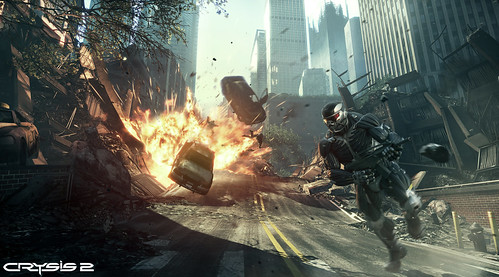
Why is it always the Big Apple?
 Which of course brings us to the graphics. Crysis was famous for its system hogging visuals synonymous for hardcore PC gaming. I only got to play Crysis for the first time last summer, when time had forced me to update my desktop. Supposedly Crysis 2 is more lenient on PC specs than its predecessor, suffice it to say Crysis 2 still looks absolutely amazing. There aren’t enough adjectives in English language to convey how good it looks or how well it runs. Even on the humble xbox there was little in the way of frame rate issues and runs like a dream. I perhaps wouldn’t go as far to say that Crysis 2 is the best looking game on the market. I would say that it is at least on a par with Killzone 3 on the Playstation but it is definitely in the upper echelons and considering how open ended the game is it is amazing feat on the part of Crytek, particularly when you are used to seeing such high polished sheen in the more linear FPSs like the latest COD games.

The artistic direction is all there to make full use of the latest incarnation of the Cry Engine, at times as you negotiate the streets of New York, the game feels photorealistic. It may only be the odd soldier animation that will put you off. Sometimes enemies will get stuck in walls and remain walking on the spot, there are a couple of AI glitches and some graphical pop in issues but nothing too serious to break the game. The environments themselves are oddly beautiful, burst drain pipes lead to urban rivers, running over chipped concrete and cascading as waterfalls over craters housing the remains of a doomed dropship all under the red glow of the setting sun. It sounds like pretentious poetic waffle, but this is what the game looks like and it is quite simply a joy to behold. Nothing short of a feat of graphical wizardry. I found myself drawing a lot of comparison’s to Bulletstorm which came out a couple of weeks ago. Both games have sections that force you to play through dilapidated buildings that lie effectively on their side, but Crysis 2’s depiction of Manhattan just puts Bulletstorm’s failed resort utopia weep.

In addition to the campaign there is also a versatile multiplayer mode. Which is in line with the parameters set by the Call of Duty MP experience. The suit becomes as big an element to the experience as it did in the single player, allowing you a choice of several classes before giving you the opportunity to create your own class. The normal death matches quickly become tiresome, as you are time and time again shot in the back or spawn killed by somebody in stealth mode, but the objective team based games are where the multiplayer really gets going. One decent innovation is lifted from Battlefield: Bad Company 2 where you’ll remember whenever you knifed an opponent you would gain the extra satisfaction by prizing the player’s dog tags from their cold dead hands. Crysis 2 adopts this quirk, whenever you drop another player, he’ll in turn drop a dog tag for collection. Attainment of dog tags grants you access to the usual killstreaks. It is a neat innovation, as it prevents long distance campers from racking up killstreaks. Plus, whenever you kill an opponent, the impetus is on you to retrieve his tag which will go against defensive styles of play. Corridors and lines of sight become increasingly important because even if it looks that no one is there, you can never be too sure.

The multiplayer is serviceable, in my opinion it’s not quite as good as Killzone 3 and it doesn’t have that degree of variation and randomness that Halo has, but it makes for a fun distraction from the single player campaign, which you will want to play a couple of times anyway. I did find some issues with matchmaking, it is not as efficient as either Halo Reach or Black Ops and there can be some annoying bugs in regards to hit detection. If you get a group of friends online, I’m sure it will be far more enjoyable as the gameplay allows for more co-operation through communication. Indeed, you are left thinking that a co-op mode of some form is missing, but perhaps this would be too taxing on the engine.
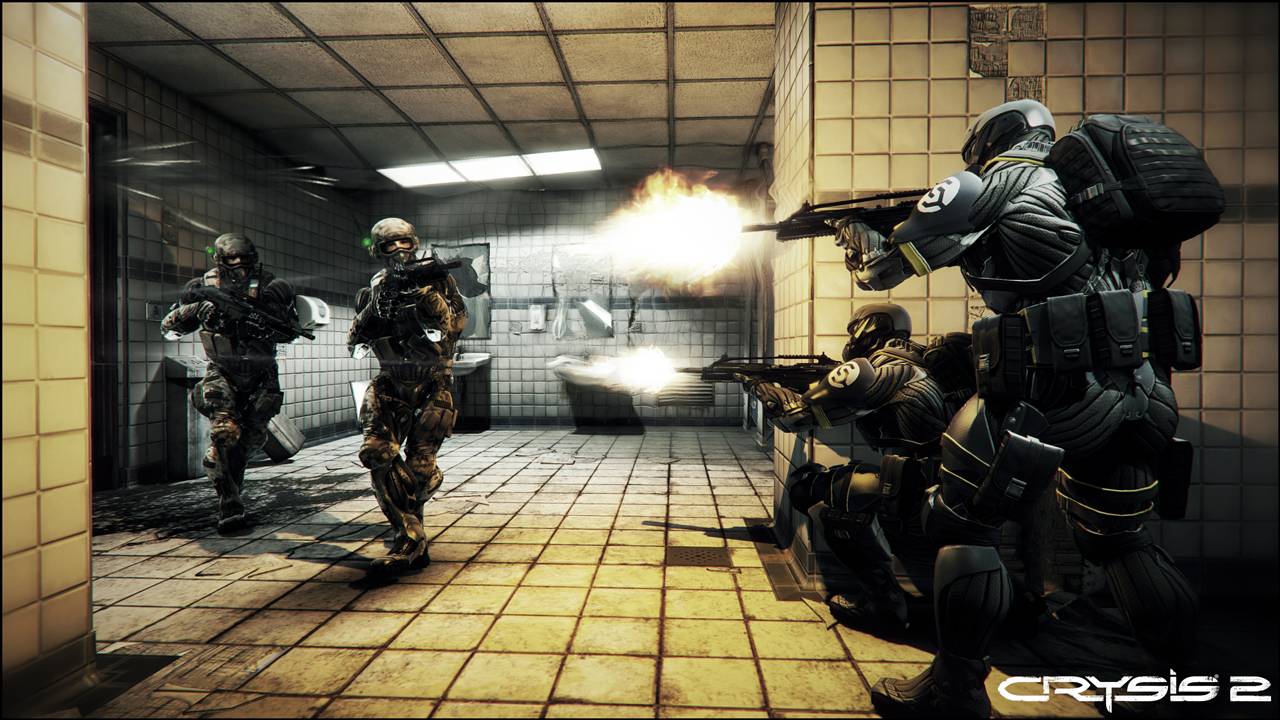
Bathroom assault.
With that said, Crysis 2 is a great package as it stands. Though some jaded PC gamers may feel like Crytek have sold their soul by developing for consoles, Crysis 2 improves on the formula established by the first Crysis. The gameplay has been refined and made all the more accessible, from the nano suit to the open but confined city environments and it all plays remarkably well on the controller. The surprisingly lengthy single player campaign is worthy of replay thanks to the variety of options the game offers you. It is let down by a generic story and a lack of variation in enemies which doesn’t do the game’s stellar presentation values, be it the fully blown orchestral soundtrack to the awe inspiring depiction of apocalyptic Manhattan island any favours. Whilst the MP allows players to find further uses for the nano suit, and does manage to retain the game’s sheen it does feel too much like an add on to keep its contemporaries from laughing at it. Those who are getting well worn by the linearity of many a corridor shooter will find the open ended tactical feel very refreshing and also, the graphics are also very very nice. 
 
8/10

Saturday, 12 February 2011

Need For Speed: Hot Pursuit - the quick and the dead


*This review was originally written for Crude Pixel. 

Title: Need For Speed: Hot Pursuit
Platform: Xbox360/PS3
Rating: PG
Genre: Arcade Racer
Developer: Criterion Games
Publisher: Electronic Arts
  
I have killed plenty of virtual people during my video game career, committed various heinous acts of violence and attained the dastardly achievement in Red Dead Redemption. Despite this, I harbor a deep an unusual prejudice against the street racing genre based on the moral grounds that driving over the speed limit and being a general nuisance to a local albeit virtual community is just wrong. I cannot seem to shake the feeling that I shouldn’t be breaking the speed limit and bashing into commuters within a residential area. If you are like me, you will find much to enjoy with Need for Speed: Hot Pursuit which gives you the opportunity to play as the police, allowing you to bring swift and brutal justice to all those awful racers out there. Whether these are the kind of racers exiled from The Fast and the Furious franchise, who wear their trousers at their knees listening to their stupid music as their accompanying lady friend climaxes all over the front passenger seat to the sound of their over powered small penis compensating engine or whether they are just the more affluent racers who believes that being able to afford a Bugatti Veyron automatically gives them a license to drive dangerously, you will feel perfectly at home taking these felons out from behind the wheel of your souped up police car.


It is true, that there have been many Need for Speed games over the last decade or so to the point that EAs brand has effectively become a complex mish mash of titles that cater for both the driving simulator and arcade racer fans. Following EA’s admirable though failed mission to promote new and original IPs in 2008 (which led to Dead Space and Mirror’s Edge) the publishers have turned their attention into reinventing their core series, hence last year’s Medal of Honour, a new SSX game and a revamp of Hot Pursuit. There have already been two Hot Pursuit games, the first was released on PSone in 1998 and the second was released for the following generation in 2002. In order to bring the series out of retirement, EA turned to Guilford based development team Criterion games who already boast much success with the genre through the Burnout series, which peaked with 2009’s Burnout Paradise.

Need for Speed: Hot Pursuit is located within a fictional area of the North American landscape called Sea Crest County, which plays host to a series of illegal racing events. Far from being beaten, the authorities have decided to get even, by putting a stop to these races via specially engineered supercars. The game essentially consists of two career modes, one in which you play as the cops and the other where as you play as the criminals… or the racers. Completing races levels up your profile and unlocks new vehicles and challenges. There are over 60 cars in the retail version of the game (there are more available through DLC, naturally) ranging from Lamborghinis, Maseratis, Porsches, Koenigseggs and of course the Bugatti Veyron. Ferrari’s absence from the game is felt but there are enough to keep you busy. Whilst both careers are essentially made up of the same kind of events, time trial modes, one on ones and races, they are linked by the hot pursuit mode. An almighty race between eight cars who will also have to contend with the pursuing police forces. It is a highly climatic affair that builds and builds until the finish race is reached or the last racer is put out of commission. Each faction has an assortment of equipment and abilities including, spike traps, emp locks, road blocks and helicopters, which you will use to battle the other side and potentially to screw one another over. Hot pursuit mode is easily the best mode of the game, to the point that the normal races become slightly mundane. With that said, Criterion have succeeded in making a phenomenally exhilarating racer that evolves the genre dynamically, competitively and in accessibility.   

The sign says stop!
   

The first thing that will become apparent when playing Hot Pursuit is the sheer feeling of speed, which is absolutely unparalleled by any other racer that exists upon the market today. All cars have a nitrous injection, which is earned by powersliding, drafting and taking short cuts. This will help you get to top speed which isn’t necessarily the watershed. As you progress through the game, you unlock faster cars and eventually during the racer’s campaign you will unlock the turbo boost, which when used essentially transitions as a jump to hyperspace. Going fast in Hot Pursuit is an adrenaline rush and makes the game all the more addictive, literally putting the need back into Need for Speed. Of course, the faster you go the more risk you are taking, as you evade traffic and other obstacles upon the roads. Lest you want to go the way of Ratts Tyerell.

It is easy to see the spirit of Burnout in Hot Pursuit through the crashes, spectacular slow motion replays of soon to be written off supercars rolling to the symphony of twisted metal and shattered glass. Whether you are the victim or the perpetrator it is quite the definition of the old saying, of not being able to look away from a car crash. As the perpetrator, it is an immensely satisfying moment as you zoom on ahead but as the victim it can be crushing and towards the end of some of the later races it can spell the difference between first place and failure. The threat of crashing keeps you on your toes for most of the game and only increases the faster you go, and faster you’ll want to go.

Sweet justice. That will learn ya...
The routes you drive upon range from open roads that blister through low lying deserts or hang precariously off cliff sides overlooking the ocean. Other routes take you through snowy mountains and redwood forests, whilst others have you weaving through traffic on snaking freeways. The imagery is purely American and looks great as you zoom on past. There are also numerous shortcut routes that you can take to avoid the fuzz or gain an advantage within a race. Most are off road, and to utilize them to their fullest potential you will need a sturdier vehicle, the lower lying high performance vehicles will actually go slower through these routes, which adds a bit of balance to multiplayer. There is a subtle emphasis upon strategy that is implemented into the design of Hot Pursuit, which will require the player to think about their choice of vehicle. Stronger vehicles will help you last far longer against the police whilst faster vehicles will obviously give you the advantage in speed. Playing the different modes of each career isn’t necessarily an exercise of driving your most recently unlocked vehicle.

Thinking about how you are going to race will become more prominent through Hot Pursuit’s autolog feature. If you have friends playing Hot Pursuit, the game will automatically display their race times upon your dashboard. Though each race has the usual, bronze, silver and gold attainment of medals, if a friend has beaten your best time you will want to rectify this situation as soon as possible and so you enter the game’s highly competitive arena. During game you can take pictures at any point with a touch of a button and you can post these to your wall for your friends to see. Beat a friend’s time and you can type a message to rub it in their face. Previously, you could do this with any game but the genius of Hot Pursuit is in implementing it so fluidly within the game’s design. You can bet that more games are going to start doing this.

There are only a couple of niggles, as I have said before, the normal races that don’t feature the police are fairly boring in comparison to the headlining hot pursuit mode. Since this is a Need for Speed game, I guess the game couldn’t have shipped without your normal race modes. The game can be played in first or third person, as is usual for most racers of course, but why you would want to play the game in any for other perspective than first person is beyond me, unless if its just to see the Bugatti Veyron's spoiler come out when breaking. The game also includes a sound track of various different artists ranging from The Klaxons to MIA and whilst it is more a question of personal musical preferences I felt that there was a lot of filler in between some of the decent tracks. However, you probably won’t be too bothered by the musical soundtrack under the colossal sound of your engine as you takedown an opposing vehicle.   


VROOM VROOM DAKKA DAKKA!!!

Serious driving simulator fans will probably groan at the game’s errant simplicity and sense of unreality. For everybody else, they will enjoy a highly accessible and replayable racer. Needless to say Need for Speed: Hot Pursuit is a triumphant reboot of the series and the racing genre in general. It manages to simplify the usual racer by putting a much needed emphasis back upon speed but deepens it by allowing the players to employ a variety of different styles, whether it be aggressive, speedy or somewhere between the two. Its revolutionary social stat tracking adds much competitive life to the game that will last long after you have gained every gold medal.        
             
9/10

Tuesday, 1 February 2011

Dead Space 2

Oh God, what the hell are you?
In space, as the saying goes, no one can hear you scream. This is not specifically true in regards to the original Dead Space of course. Placed in control of Isaac Clarke, the player would have unquestionably heard the engineer’s muffled screams of anguish as he was unwittingly bashed around by a particularly grotesque parasitic alien menace within the claustrophobic industrial confines of the USG Ishimura. First released around Halloween in 2008, Dead Space reinvigorated the survival horror genre months before Resident Evil 5 could even have a chance to disappoint us. Though receiving very good reviews, Dead Space did not sell well initially, quickly finding itself in bargain bins across the country, but this did ultimately work in the game’s favour as word of mouth began to spread and it developed a dedicated fanbase. Dead Space was a tightly paced, highly tense sci-fi horror game with absolutely stellar production values that served to create a wholly immersive experience.  It may not have been the most original game, building as it did upon the third person foundation set by Resident Evil 4, but it did redefine the genre through a number of intelligent twists, such as tactical dismemberment of your foes, a subtle HUD system and an emphasis on actual horror and tremendous isolation. Two years later, Dead Space 2 has finally been released and supposedly: this time, its war.

After successfully escaping the USG Ishimura in the original game, Isaac Clarke finds himself three years later contained within a psychiatric ward, clinically diagnosed insane and suffering from intense hallucinations of his dead girlfriend Nicole who tragically committed suicide onboard the Ishimura before Isaac could reach her. The game begins in an unapologetically grotesque manner, when an orderly attempts to wake Isaac only to be turned into a necromorph before our very eyes and thus begins a harrowing sequence in which you must escape your asylum whilst dressed in a strait jacket during a necromorph outbreak. It is a jarring opening as you wander around defenseless with little health. Eventually, however, you gather your usual array of weapons, tools and armour and proceed to discover how and why the station has been infected and why Isaac keeps seeing his dead girlfriend and also why pesky government gun-ships keep shooting at him. 

Whilst Dead Space 2 plays more or less like the first game, there are a couple of big changes. The biggest is the promotion of Isaac himself into a full speaking character.  In the first game, Clarke was a Gordon Freeman styled mute who remained largely faceless throughout. In a way this emphasized the horror and isolation of the experience, as you were haplessly ordered around to different areas of the ship in order to divert some life threatening catastrophe. The refreshing thing about  Isaac was that he wasn’t your usual space marine or special forces commando with arms the size of watermelons, he was an engineer tasked with repairing a spaceship which just so happened to be infested with a horrific alien presence. Fortunately in Dead Space 2, fleshing out the character of Isaac is done particularly well, you become more attached to Isaac as you play on through and there are a couple of moments towards the end which easily make him one of the more memorable characters in the great pantheon of gaming. Part of the story of Dead Space 2 deals with Clarke’s loosening grip on reality and the psychological torment he feels as a result of the event of the first game. It doesn’t help that he keeps seeing a mutilated version of his dead girlfriend with glowy eyes that constantly taunts him reminding him of his life failures.  I know… Women, right?

The other big change is the setting, Dead Space 2 is located within a large metropolis known as The Sprawl which is located on Titan, one of the moons orbiting Saturn. One of Visceral Games’ triumphs with the first game was in the creation of a believable space ship environment, from medical bays, to dormitories right on through to the dark and dank sub levels of engineering, you believed this was once a functioning ship board community where hundreds of people had worked, slept and relaxed, before they fell into disarray. Up until the release of Dead Space 2, Visceral have been building up players into expecting a new kind of city environment in which we’ll witness the cataclysm happening in present tense. It is a smart move and development from the first game to be sure, but unfortunately with exception to a couple of scenes in the early stages you never really get the sense of the scale of the city or the pandemic that has engulfed its society. Occasionally you will pass a window that looks out on to your typical sci-fi cityscape and there are plenty of times when you are ingratiated with the grand sight of Saturn and its accompanying rings, but these scenes are all to brief. It is as if the game is always focusing you down the next corridor.     


I am in a space city. Watch it burn.
Another problem related to Dead Space 2’s city setting is that the environments are very familiar. There is a brief visit to a shopping centre complete with accompanying easy listening music in the background, as we have seen in both Dead Rising games.  The church of unitology, the hub for the game’s foregrounding religion (think of a right wing version of scientology gone mainstream), is vaguely reminiscent of the purple and blue hues from the Covenant spacecrafts from the Halo games. Then there is a visit to a dilapidated pre-school, which tries in earnest to create fear by juxtaposing the innocence of its childhood setting with the body horror of the necromorphs. It all comes across as very clichéd, and most gamers will have been through these kind of environments in numerous franchises, FEAR, Silent Hill, Left 4 Dead and most prominently Bioshock.

The Sprawl is never as well realized as the underwater city of Rapture. Bioshock allowed the player to explore the wards of this miraculous utopia turned dystopia to a far greater extent and as a result you got a chilling sense of what the city was and what its inhabitants were like before the cataclysmic events that led to its downfall. Dead Space 2 could have really benefited from a similar layout. Afterall, one of the things that I really like about Dead Space is the world Visceral games has created around it, from the process of planet cracking which effectively acts as the usual environmental commentary on mankind’s exhaustion of natural resources to the conflict between the space age government and the church. The game world demands the kind of added depth that Bioshock had.  A greater emphasis on the city would have also improved the horror, questioning the player with a risk versus reward kind of dilemma.  Should I turn right and diligently carry on to my objective? Or should I turn left and see if I can score some much needed supplies? This would have been a proper evolution from the original Dead Space.  As it stands the environments of Dead Space 2 really affect the overall satisfaction of the game.  It just emphasizes how linear the game is, forcing you down corridors of a different colour past the demented scrawling of ‘I DON’T WANT TO DIE’ on the walls and the obligatory jump out scare moment that will inevitably lead to the zero-g puzzle sequence.                          

Thankfully, the combat, which was one the first game’s strengths remains as good as ever. Combat whether it be in third or first person is usually always focused upon the headshot. The great thing about Dead Space was that it required the player to take an alternative approach to defeating your enemies. The necromorphs which are basically reiterations of the monsters from John Carpenter’s remake of The Thing, cannot merely be defeated by frenzied shooting to the upper chest or head. Indeed this will often make things worse. You have to think tactically, like cutting off their legs to slow them down, or removing their scythe like limbs to reduce the potential damage they could inflict upon you.

The usual weapons are back, the trusty plasma cutter for precision dismemberment. The indispensible Ripper for close quarters mutilation. The generic pulse rifle for short controlled bursts and when situations call for a ‘lets rock!’ kind of crowd control moments. The flamethrower from alien and of course my personal favourite the contact beam for boss humiliation.The force gun still remains as useless as ever and will probably never leave your inventory safe. There are a couple of new worthy additions to the arsenal.The javelin launcher, is essentially a harpoon gun which can pin enemies to walls and the trip mine gun allows the player to lay traps.There is a precision rifle, a more conventional firearm that feels a bit flat against the tried and tested favourites but is at least effective at blowing limbs away from long distances. As in the first game, each weapon can be upgraded via a nuanced development tree, which will greatly enhance your chances especially on the harder difficulties. 

This is a good thing because Dead Space 2 is a far harder game than the first game. There are four difficulty levels to choose from when you start a new game. Optimistically, I opted for Zealot, the hardest setting, having proudly gained my Epic tier 3 Engineer achievement from the last game. This decision proved to be overly ambitious as I quickly found myself lacking in ammo and health. With much regret I relegated myself down a level and found the game much easier to play through. That is until I reached the final chapters, where the game just throws the enemies at you. It is tremendously unforgiving, it’s not exactly scary in any way because you become used to watching the horrific death scenes over and over again. I reached the decision where I just couldn’t be asked with completing the challenge and so relegated myself once more to normal. Luckily, as with the first Dead Space, you are bound to limp through on your first attempt, it is only on your second attempt where you play through with your upgraded weapons that you actually get better at the game. The game isn’t as scary of course by this stage of course but the satisfaction of laying the smack down on all the alien bastards who caused you much grief early on makes it worth it. Very much like the nature of fear itself, Dead Space is easier to cope with once you know what you are going into. If this idea doesn’t cut it for you then you could also try the new ‘Hard Core’ mode, where ammo and supplies are even more scarce, the monsters will kill you in one hit and you are only allowed to save your game three times throughout the entire campaign.            

          Won't someone think about the children?

The game also includes added variety to the first game’s bestiary. The common necromorph slashers will still run at you screaming like an angry pirate and the leapers are still a problematic enemy to deal with since they are always just below your eye line when they attack you. The bull like Brute returns and once again is easy enough to kill once you blow off its arms with the contact beam. As the game is set in the city, Visceral have tried to incorporate new enemies that represent the population who have been turned into necromorphs. Most alarming are swarms of infantile necromorphs, easy enough to take out individually but on mass they can become quite formidable. Then there are the pukers, enemies who projectile vomit over you from a distance (hmmm… wonder where they got that idea from…) who quickly identify themselves as complete and utter bastards. The best new enemy are the stalkers who have been heavily influenced by Jurassic Park. They are fast moving predators who hunt in packs and will playfully peek round corners at you before they charge at you. Running after them will often send them fleeing but you will of course be open to flanking attacks. You only ever fight these enemies in maze like locations. Literally, whenever you come across a room full of crates you know what it is you will have to deal with, but these sequences do at least switch the role of hunter and hunted quite well. In the first half of the game, most enemies aren’t much a problem so long as you refrain from panicking, use the right weapons and place your shots well. It is only in the later stages of the game when the base models develop into the black badass incarnations with the red glowing eyes that things start to become a little hectic. 

Disappointingly there are less boss fights in Dead Space 2. Fans of the first game will remember the zero-G fight against the leviathan or the final boss, a monolithic creature that seemingly came out of nowhere. There are a variety of large spidery tripod walker enemies, which are easy enough to take care of and a highly scripted sequence in which you fight a tank like creature with a large T-Rex mouth. Dead Space 2 relies far more on these kind of set piece moments rather than boss fights and these are admirably executed with great energy, a fight through a moving train is one such memorable moment from the early stages of the game. A later sequence involving a rocket powered free fall is essentially a familiar component to the modern action adventure game, but is still exhilarating nonetheless. As with Dead Space, a lot of the game will lock you in areas under the guidance of quarantine where you will be forced to defeat waves and waves of necromorphs before the lockdown is lifted and these are often the more difficult sections of the game.
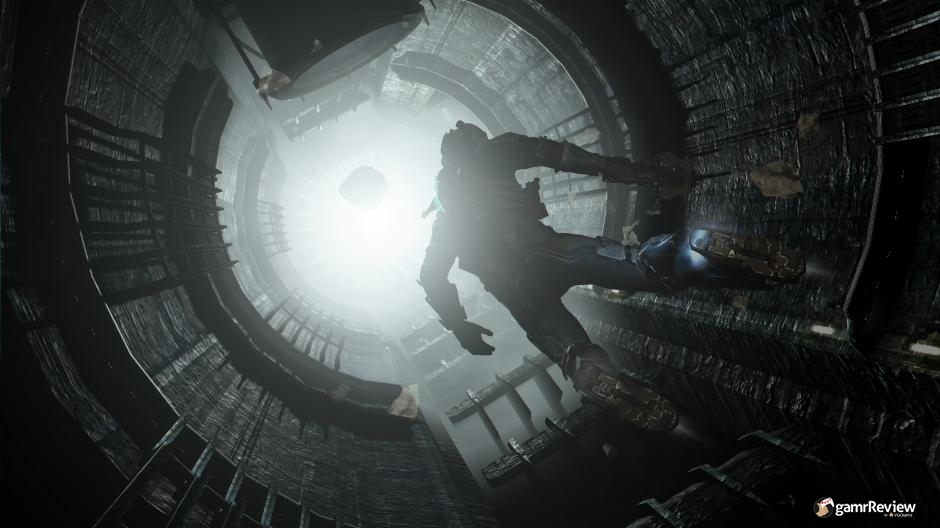
Dead Space 2 also has improved zero-g sections where you soar like Iron Man.
Aside from the single player campaign, Dead Space 2 includes a multiplayer versus mode.  Four players play as engineers and four other play as the necromorphs, Left 4 Dead style, but not as good. I don’t understand why a Gears of War styled co-op horde mode wasn’t released for the game, which would have surely suited the game better. As it stands, the game mode, is quite good fun for the first hour but starts to wear thin based on how overpowered the humans are. It seems to exist solely for commercial reasons as a way of combating the used game market, since to play MP, the user must have an activation code, which you will get for free if you buy the game at full retail price. Most people can probably do without the MP mode to be honest because the single player is the main draw. Of course, if you are lucky enough to own a PS3 you can get the limited edition version of the game, which comes packaged with spin off game Dead Space: Extraction, an on rails light gun shooter originally released for the Wii in 2009. This game is a complete and utter blast, it has been a while since I last touched a light gun game (probably since House of the Dead 2 for the Dreamcast) but Extraction is an excellent story based game that is of worth to any fan of the franchise. In some ways I actually preferred it to Dead Space 2, which says something.      

Like Gears of War 2, Dead Space 2 suffers from the common problem surrounding that difficult second game, namely the mentality to remake the first game, though bigger and more badass... As with Gears of War, Dead Space was excellently paced in the style of the greatest Hollywood action blockbusters whilst being tightly contained as a complete experience. Though it is not as bad as Gears of War 2, the setting is Dead Space 2’s downfall, effectively making the game become a retread through the same kind of corridors of the first game. The game is also quite inconsistent, a strong first act gives way to a flabby middle section punctuated by a handful of highly scripted set pieces and ending with an explicitly difficult final few chapters and a rubbish final boss fight. Whilst trying to make the game more epic and badass the game has sacrificed a lot of the creeping dread of the original game. I know people who couldn’t complete Dead Space because they were too afraid (cowards all…). Hopefully they may find Dead Space 2 much easier but as far as horror is concerned, the game certainly doesn’t hold a candle to Amnesia: The Dark Descent. With that said, the game remains very polished and immersive albeit to a blunted extent in regards to horror and location. It does the core combat very well, tactical dismemberment is as satisfying as it was in the first game and Visceral’s development of Isaac Clarke is also very well handled and will be the main reason to return to the franchise when Dead Space 3 is inevitably released. The best moments in the game range from when you are desperately running around under siege from Necromorphs gathering ammo where ever you can to the moment in which you feel like an alien hunter. It is not as consistently well paced or designed as its precursor, but Dead Space 2 still at least remains an enjoyably third person action adventure.