Tuesday, 13 August 2013

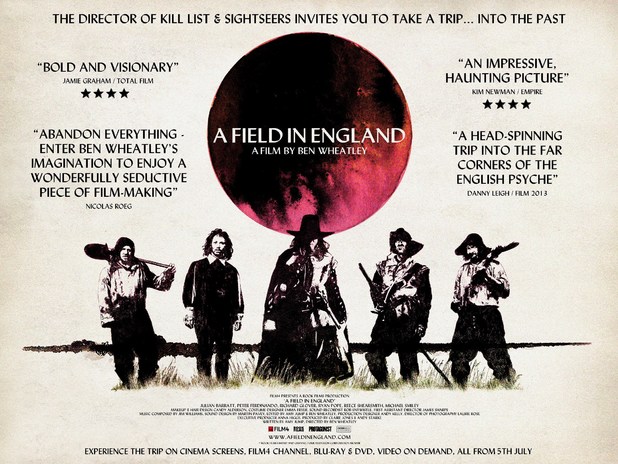
A Field in England - "Open up and let the devil in!"

With all the authority of someone who has never taken drugs before. This film is definitely a trip.
Britain... Britain... Britain...  

On one hand you have Edgar Wright, and on the other you have Ben Wheatley. Two British film-makers who use the reality of what it’s like to be British as the basis for their films. Teaming up once again with Simon Pegg and Nick Frost, Edgar Wright released The World’s End, the concluding piece of ‘the cornetto trilogy’. Three films that have infused big cinematic conventions to a small English setting, much to the ring-a-ding-ding of the box office.

By contrast, Ben Wheatley has gained a reputation for making a number of off-kilter films, such as 2011’s unbearably harrowing viewing experience Kill List and 2012’s black comedy Sightseers, both followed this year by A Field in England. Wheatley’s films won’t set the box office ablaze (not yet at least) but his films are quintessentially British. He has the talent to put the audience in a state of great unease, exploring a very British sense of madness delving into violence though not without tongue being placed firmly in cheek.

Released simultaneously across cinemas, TV, video on demand and DVD, A Field in England is shot entirely in black and white with a small ensemble cast on location in… well… a field in England. The film is a drug-induced period piece, that ventures into the 17th Century to the time of the English Civil War. Strangely, this period of history hasn’t exactly had the big cinematic treatment despite the period’s obvious wealth in terms of themes and spectacle. A Field in England is not the big cinematic treatment, in fact, a part of me did think that it could just be a bunch of guys taking part in a modern day battle re-enactment. A couple of guys who take the role-playing a bit too far of course... Post it to r/fantheories I guess...  


There is a plot. Allow me to explain.   

From out of the roar of canon fire of a particularly grueling battle, emerges Whitehead (Reece Shearsmith) – a cowardly scholar who is fleeing from his master (Julian Barrett). Whitehead’s only task is to bring a known Irish outlaw and alchemist to justice, something he has failed at pathetically. Escaping his master’s clutches he bands together with three lowly footsoldiers: Jacob (Peter Ferdinando), Cutler (Ryan Pope) and a benign simpleton known only by the name friend (Richard Glover). Deserting the battlefield, the group go in search of an alehouse. An appropriate starting point for any adventure. The alehouse never comes however, and the group soon find themselves lost and under the influence of mushrooms. Then emerges O’Neil (Michael Smiley), the very man Whitehead was originally supposed to be looking for. Being a meek scholar, the tables are quickly reversed on Whitehead, as the villainous O’Neil enlists the group to search for a great treasure he believes is buried underneath a particular field that is covered in hallucinatory mushrooms.

Let's look for treasure.
A Field in England is best understood as a story about the British male and the notion of power. Providing historical context is the civil war, but it isn’t something that is explored with any particular detail during the film, even though you can read into presentation of the historical period. The war defined the future of Britain, religion, government, the country’s very soul. Parallels can be drawn with today, with British society divided, handling the pressures of the global recession. Arguably, Britain isn’t great anymore. And there is something that resonates with that notion, in this - a story about five men scrambling around in the undergrowth searching for treasure that may or may not be real.  

The central power struggle lies between O’Neil and Whitehead. As the 'devil', O’Neil uses fear to control the group. Michael Smiley uses that harsh Ulster drawl to menacing effect, (“Open up and let the devil in!”) especially in contrast to  Reece Shearsmith’s pathetically bookish Whitehead. It is a compliment to Shearsmith’s performance that Whitehead continues to gain the audience’s sympathies, I mean this is from the guy who played Papa Lazarou! He’s one of those characters who is slightly incompetent as a human being, but someone who has experienced defeat at every turn and assumed a naturally submissive state. As somebody who once did a masters degree, I felt I could relate to Whitehead as somebody who has spent too much time within the academic bubble. He is obviously intelligent and in possession of rare skills (including lacemaking!) but his attention is drawn towards books rather than reality which is at odds with the other characters, who can adapt better to the deserter's life and a diet of mild altering mushrooms.


"Go on, say 'Have a Banana' one more time. I dare you..."
Whitehead is the learned but unlearned man, O'Neil is the outlaw and the force of suppression. As for the rest of the cast, Ryan Pope's Cutler is the soldier, somebody who can subject power over people so long as he is armed and has orders. Peter Ferdinando as Jacob is the underdog and essentially acts as the voice of the audience, addressing the shiteness of the situation they are faced whenever necessary. Richard Glover, as friend adds humour and levity in his simple understanding of the world. Even though there is more to the character than meets the eye, with a 'complicated' backstory involving his wife and a penchant to not stay dead when killed. 

Most of the cast is comprised of familiar faces from British cult comedy, Shearsmith from League of Gentlemen and Smiley from Edgar Wright’s Spaced. Julian Barrett even appears early on as Whitehead’s master. I was expecting Noel Fielding to cameo as an giant sexualized mushroom during one of the many hallucinatory scenes, but it never transpires thankfully.   

The dialogue exists somewhere between Shakespeare and Blackadder. There is a lyrical flow to dialogue, a fair amount of toilet humour and some profound lines (Cutler: What do you see friend? Whitehead: Nothing. Perhaps only shadows…). The film does feel very influenced by amateur theatre in its mechanics with all the trappings of Elizabethan theatre. Minimalist surroundings located in the wilds of nature, away from civilisation, a setting where anything could happen. It could just as easily be performed on stage, especially its many tableaux scenes, which heighten the classical elements whilst serving as chapter breaks. In which the characters stand in static as if posing for a painting or diorama. This still remains a film, however, and Ben Wheatley as always manages to create a number of scenes that are designed to have a traumatic effect on the viewer.
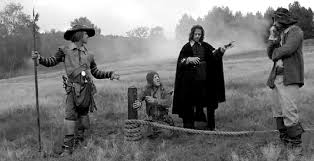
One of the film's many tableaux sequences. 
One scene that will undoubtedly leave an impression comes fairly early on. It has one hell of a setup. Whitehead has succumbed to Michael Smiley’s villainous O’Neil. He has tried in vain to reason with the irish man that he is his prisoner, but it is of course the other way round. Whitehead is invited with an open hand to descend into O’Neil’s tent. It is of course less of an invitation and more a direct order, made pretty and consensual (almost) by a fanciful tableaux sequence. Cutler stands holding Friend and Jacob at gunpoint, the latter two bowing submissively indicative of their lowly social status. At this point, Jacob breaks the fourth wall, by looking up from the ground directly at the audience, acknowledging the horror that is about to play out. What follows is almost five minutes of agonising screaming as Whitehead undergoes some nameless brutality within the confines of the tent. We don’t fully understand what O’Neil is doing to Whitehead, whether he is being raped or tortured, or submitted to some bizarre alchemical practices. We witness it only through the screaming and the grimmaces of the group outside. But then the moment comes. Whitehead emerges from the tent. Transformed. 

What follows is the single creepiest scene I have witnessed in cinema in recent memory. Whitehead walks out of the tent, his upper body bound in rope. A freakish smile beaming across his face indicating a state of higher consciousness existing somewhere between Nirvana and pure terror. He walks out of the tent in slow motion as if learning to walk again, all the while that demented grin spread across his face as he moves past his comrades, staring them down. All to the sound of a euphoric melodies of Blanck Mass’s Chernobyl. It is a deeply unsettling sequence though mesmerizing at the same time. Gives me shivers just thinking about it… ehhhh…

The mushrooms and drug-induced sequences are of course another focus of the feature. They essentially serve to transform Whitehead from meek academic man servant to civil war duel pistol toting Popeye. Wheatley includes a number of startling hallucinatory sequences, employing double and kaleidoscopic vision. Under the effect of mushrooms, the field appears blasted by the elements, swept with wind, and an ominous black planet appearing in the sky. Having never really experienced the effects of drugs (you’re going to need a large enough dosage…) it does provide a rush which energises the film after it’s predominantly black and white stillness of its first and second half. The rush comes from witnessing the transformation of Whitehead, his mind enlarged, as he drops his studious and celibate qualities to battle the devil. Apparently, drugs can be good for you, I don’t know what Mr Mackey was talking about…    

"Go on, say 'hello Dave' one more time. I dare you". 
The film ends quite predictably enough. Whitehead, with the help of Jacob and the seemingly invincible Friend betters O’Neil, with a shot that blows through his right eye socket. Whitehead, seems to assume the mantle of his suppressor, perhaps to take his place, returning back to the battlefield where events began, perhaps with a new sense of bravery, perhaps to entice a new group of stragglers into looking for more gold, where he can further study the alchemical properties of the mushrooms to a greater degree. Either way, Wheatley has provided the entire final reel, for amateur film makers to download and create their own edit. Noble.

It is perhaps a fitting end to this experiment of a film, that largely allowed audiences to see the film their own way. Despite being set in the 17th Century, A Field in England is very much founded on that punk mentality. Coming from nothing, with the help of the most basic resources to achieve… something. 

But what does this say about England today? I hear the sensible film critic say? That we should gorge on copious amounts of mushrooms and then go trigger-happy in the houses of parliament? Definitely! Let's do that! No, I think my understanding is a lot more simplistic, be your own man and step out of your comfort zone, don't be a slave to institutions, or anyone who is primed to take advantage of you. Open up and let the devil in - by all means, but be ready to moderate his attachment over you.    

Michael Smiley was just one of the great things about Spaced. 


Friday, 9 August 2013

Only God Forgives - Ryan Gosling will hurt you.

"Wanna Fight?" 

I just want to say something about Ryan Gosling first of all.

It doesn’t matter what gender you are, what sexual orientation you are, or how insecure or confident you may be in your own appearances. No one can deny that Ryan Gosling, as far as male human beings go, is a pretty damn fine specimen. Gosling has gained a reputation for being a quiet one in movies, adopting a ‘less is more’ approach to acting by not saying much at all. Of course, he doesn’t need to, because he is so good looking. Who needs words when you’re Ryan Gosling? Whatever scene you are pitched in, you draw in audiences automatically like a tractor beam – moths to the flame. Words and indeed the traditional point of having dialogue in films - whether it is to move along the plot or add emotional substance or colour becomes utterly meaningless. Unworthy of Ryan Gosling, who almost seems to be lampooning the archetype he so easily could be typecast. People go to the cinema for spectacle, Ryan Gosling’s face is that spectacle. Words are extra. 

Of course, Gosling could quite easily have become the next Matthew Mcconaughey. Picking up a series of sumptuous pay cheques from a string of crowd pleasing romantic comedies. But he doesn’t. He did the Notebook and a few others, but that was it. He knows he could so easily be typecast, which is why he teams up with directors like Nicholas Winding Refn who have the ability of amping up his on screen persona to the sublime, where his normally immaculate visage begins to crack and denature.

Still would? Of course you would... 
This was evidenced by 2011’s Drive. The only way to snap audiences out of the Ryan Gosling effect is to have his character partake in tonal extremes. To paraphrase Ed Norton’s character in Fight Club, to destroy something beautiful.  Drive, in my opinion, was a fantastic movie of old school execution and sensibilities, but at the time of release the movie seemed to rub audiences up the wrong way. The main reason, seemed to be focused on the film being mis-marketed as a thriller with car chases starring Ryan Gosling, but in actuality it was a far darker affair laced with scenes of the old ultra violence in which the blue eyed, blonde haired poster boy at one point threatens to hammer a bullet into the forehead of an unlucky plebian. 

And so we come to the Gosling/Refn tag team’s latest feature Only God Forgives. A title that shouldn’t mislead audiences into the multiplex, not like last time. Well… all those who didn’t like Drive will presumably be AWOL, safely wrapped up in another screen watching the Smurfs 2 presumably. I can almost guarantee that all those, hoping for a spiritual successor to Drive however will feel misled. Also disappointed and potentially violated, because Only God Forgives is a completely different movie.       


Julian (Ryan Gosling) is the owner of a boxing club in Bangkok, which serves as the legitimate front to his family’s drug dealing business. When his dickheaded brother is killed after murdering a 14-year old local girl, his mother Crystal (a barely recognizable Kristen Scott Thomas) arrives in from the US to collect the body. Crystal is the head of the business and is angry when she finds out that Julian has apparently neglected to seek and snuff out his brother’s killer. The culprit is a policeman turned vigilante by the name of Chang, who has a preference for administering an old testament, wrath of God styled justice by way of a short katanna sword he seems to unsheathe from thin air. After the family put out a hit on Chang, events escalate, ultimately pitting Julian against the seemingly unstoppable ‘angel of vengeance’.

Ho boy. So in that last paragraph - the obligatory set the plot up for the reader paragraph - I tried to leave you, the reader, feeling compelled into finding out how it all ends, whether Ryan Gosling bests his brother’s killer. This is usually done so as not to give away the plot and also for you to keep reading. It becomes very clear in this movie, that there is only one way this story is going to end and that goes double for Gosling's character.  

When you think back to Drive, you think about the tangibility of its world and characters. LA was as big a character as its cast, whether it was from the perspective of the city at night or driving through the storm drains by day. The world of stunt driving and indeed getaway driving, is where man and machine are symbiotically connected. Even the manner in which the film was made was refreshingly old school, with little computer generated effects and a masterful display of cinematography. The characters too, were all functional in their own way, Bryan Cranston as the friendly fatherly fixer, Ron Perlman as the big bad, Casey Mulligan as the girl stuck in a bad place and of course Ryan Gosling as the blue eyed hero. Finally, the era it was set felt vintage, a simpler time viewed through a rose tinted lense. There was a tangible sensibility in its method, functions and tone. 

Best line from the film: "Remember, Girls... no matter what happens, keep your eyes shut. And you men... take a good look." 
Only God Forgives, in contrast is far more art house in design. It feels more like a product of Thai cinema, its concrete jungle plagued by sin and over violence, in dire need of somebody to clean up the streets by any means necessary. At the same time, there is a feeling of intangibility, an almost dreamlike quality. The neon lit labyrinth corridors of nightclubs and 'interiors' that it is set within is deliriously reminiscent of Nolan’s piling dreamscapes from Inception. Many dens of opulence also feature depicted with an OCD attention to detail and artistic arrangement, giving it a very 'designed' look, symmetrical and clinical and as a consequence completely out of whack. Violence and torture seem to linger at every corner however, waking the film up from its otherwise comatose state. It’s an unbearable atmosphere to be sure. It is also a film of absolutes, black and white, men and women. There may be grey area, but there is only ever one way out.     

So I’ve talked a lot about Ryan Gosling in the beginning of this piece, and it’s probably bad form, to now suggest, that this isn’t really a Ryan Gosling film. Sure it has him brandishing his dukes on the poster, but this isn’t the Ryan Gosling vehicle that Drive was. It is a fact that Gosling was not originally intended to star in the film, only doing so, when another actor (supposedly English actor attached to the Hobbit) dropped out at the last moment (probably not Martin Freeman...). Julian does have that strand of morality that was indicative of the Driver, when he admits to his mother that he believes his brother deserved to die after what he did. Part of the brilliance of Drive was in how the driver's blue eyed innocence and heroic entitlement ultimately causes more trouble than its worth. In comparison, Only God Forgives, Julian has that mentality but struggles to enforce it due to his bizarre relationship with his mother.   

Kristin Scott Thomas, in an uncharacteristic role that could only be described as a 'toxic mega cunt'. 
Gosling, who probably has all but twelve lines in the piece is outstaged by this fellow leads. Kristin Scott Thomas as the mother Crystal is a highly detestable though dominating presence. She's a bastion of fakery, botoxed face, fake breasts, fake tan and leopard skin dresses. We question if she even cares for her remaining son and everywhere you feel that she has damaged her remaining son extensively, to the point that no third act resolution or inspiring montage can repair. Freud would have a field day because there is a very creepy Oedipus complex at work, and though he doesn't stab his eyes out, he does get them bruised which sets alarm bells ringing. 

Meanwhile Vithaya Pansringham as Chang puts in a horrifically magnetic performance – a puritanical presence dressed completely in black, with white collar, giving him a godly feeling of authority and principle. Chang has all the menace of Javier Bardem's Anton Chigurh with all the temperance of a samurai. With Crystal as the mother, there is an argument to suggest that Chang provides the paternal streak. In a sense Only God Forgives is a traditional movie, in that it is a film where the good guys win. But the way in which Chang administers justice is enough to feel sorry for scumbag victim. The humid mean streets of Bangkok is very much his jungle, and everybody else is just prey. This is his movie.  

Don't mess with this guy. Be good to one another, eat your vegetables and pay your taxes. 

As with Drive, the music is once again provided by Cliff Martinez. His score to the film’s climatic fight scene contains spiraling synths and doom mongering church organs. It sounds as if it comes straight out of a John Carpenter flick. It is probably safe to assume that it will soon feature as the soundtrack of another flashy car advert. Something silver and exquisitely designed, driving around a faceless city at night. 

Many critics seem to suggest the film is about guilt. Me? I think it’s a bit simpler than that. It’s about strangers in a strange and distant land. This land isn’t just physical but internal, a seedy neon lit labyrinth that infringes on the borders of sanity. It shows how its characters becoming estranged from each other and themselves and therefore completely and utterly doomed from the outset. But if you can rise above it, by leading a righteous life and follow all that toil and gratuitous violence with a modest karaoke performance, you should be fine.    

Some viewers were put off by Drive when that film had a distinct lack of driving. Similarly, Only God Forgives will have a misleading effect, though it will mislead the fans of Drive. This obviously puts the film’s prospective audience into a far smaller niche. Drive was tangible, it had emotion and the levity of resolution, Only God Forgives is coldly intangible with exception to the scenes of gushing violence, and for that reason it will not be for everybody. I’m not even sure it’s for me...

As I said before, this is a film where the good guy wins. But it is a nightmarishly claustrophobic piece, a lucid fever dream punctuated by scenes of distressing violence juxtaposed with nonchalant karaoke sessions. Things happen, things are said, even explained, but you are still left questioning whether anything you experience is actually real. It may be worth a second viewing for the latent symbolism to synapse. As of now, there simply has been no other film released this year that has lingered in my imagination with such a delirious impact. This must be what it means to observe the wrath of God from afar. Quite an impression, even if you don't quite believe in it... 

Thought I'd just finish this piece with a picture of a puppy. Y'know, for levity?

And who doesn't love this scene from Drive?


Tuesday, 9 April 2013

Become the River Monster - A River Monster Drinking Game for Friends


Lately, I've become obsessed with River Monsters, a wildlife series starring expert fisherman Jeremy Wade that airs primarily on Animal Planet and one of the many ITV channels if you're poor and live in Great Britain. The basic premise of the show involves Jeremy Wade travelling all over the world to hunt down a number of elusive river monsters, that is fish who have been responsible for killing humans or causing grievous bodily harm. The show is so good, that I've devised a drinking game out of it, which I thought I'd share with you here on the ass end of the internet, which is my blog.   

Please be warned, like the process of hunting river monsters, this game is for adults (though admittedly not actual responsible adults). I would also like this to open to any further amendments also. If you've got a good one message me, twitter me, or send it by carrier pigeon or whatever.  


BECOME THE RIVER MONSTER
“Jeremy Wade’s River Monster Drinking Game Challenge”


“This is exactly not what I had in mind when I started my career in fishing or indeed broadcasting. I do not want my name attached to this sordid project. You people make me sick.”
Jeremy Wade, 22nd March 2013

1.     ONE FINGER Every time danger or death is mentioned and/or you see the fear in Jeremy Wade’s eyes.  

2.     ONE FINGER Every time he says monster when he could just be saying ‘fish’, ‘large squallice’ or ‘rare river dwelling creature’.

3.     ONE FINGER Whenever Jeremy Wade’s fishing techniques can easily be read as sexual euphemisms, for instance ‘lure him in with my tasty tackle’, ‘going down on this monster’, ‘for this I’ll use my large heavy duty rod’. Single for heterosexual reference or general glorification of Jeremy Wade’s penis TWO FINGERS for homosexual reference. Last person to get the reference must down THREE FINGERS. And FOUR FINGERS if somebody embarrassingly points out a euphemism too hastily and it obviously makes no sense. This will be debated by participating agents until a judgment is finalised and the measure is consumed USING NO HANDS (though it is perfectly acceptable NAY ENCOURAGED to stick them out like fins for balance).   

4.     ONE FINGER Every time he meets the locals for harrowing eyewitness accounts. TWO FINGERS if said local has lost a limb to the creature. Everyone, must switch drinking hand for the rest of the game! If they drink from their good hand there will be a most horrific forfeit as determined by the gathered party/party master.     

5.     ONE FINGER Every time folklore is mentioned or illustrated by some lovely old time illustrations.

6.     ONE FINGER Every time Jeremy Wade gazes dramatically into the sunset or assumes a gratuitous hero pose.

7.     ONE FINGER Every time a flashy dramatic reenactment occurs (the same one they will use throughout the entire show), flash of teeth and someone screaming in the water.

8.     ONE FINGER Every time he catches a river monster, but not the river monster. TWO FINGERS when the river monster has taken a bite out of the very fish JW is catching.  

9.     ONE FINGER Every time he hauls in yet another catfish.  Everybody shouts “Dogs rule”  

10.  TWO FINGERS Every time it’s a shark - everybody sings the Jaws theme

11.  THREE FINGERS Every time it’s an alligator/crocodile or reptile. Everybody shouts ‘CRIKEY’ in an Australian accent.  A moment of silence for the late great crocodile hunter until the next drink.

12.  FOUR FINGERS if it is something even rarer or freakish than that. Everybody shouts ‘What the fuuuu’ (fuuu must exceed a pitch of middle C for both girls and boys)

13.  ONE FINGER Anytime the sea is mentioned but quickly shyed away from because Jeremy Wade doesn’t do sea monsters. Every body shouts river monsters, mutha f**ka like that dance anthem Riverside. Please see the video below if you are not familiar with this particular piece of 'music':


14.  The one who has consumed the most by the end of the show, must stand up and loudly declare him/herself as the river monster – “I am the River Monster! Fear my wrath”. They must then do a flappy fish dance whilst making the noise of the river monster. Obviously, fish do not really make noises but it’s open to the awful drunk’s interpretation at this point, for the amusement of the losers or winners depending on how you reflect on prior events or indeed life in general. Then, JW himself comes in, picks you up in his strong arms and has a picture taken with you. Alternatively you can just be lying on the floor passed out and he will pose around you before releasing you into the wild once again.